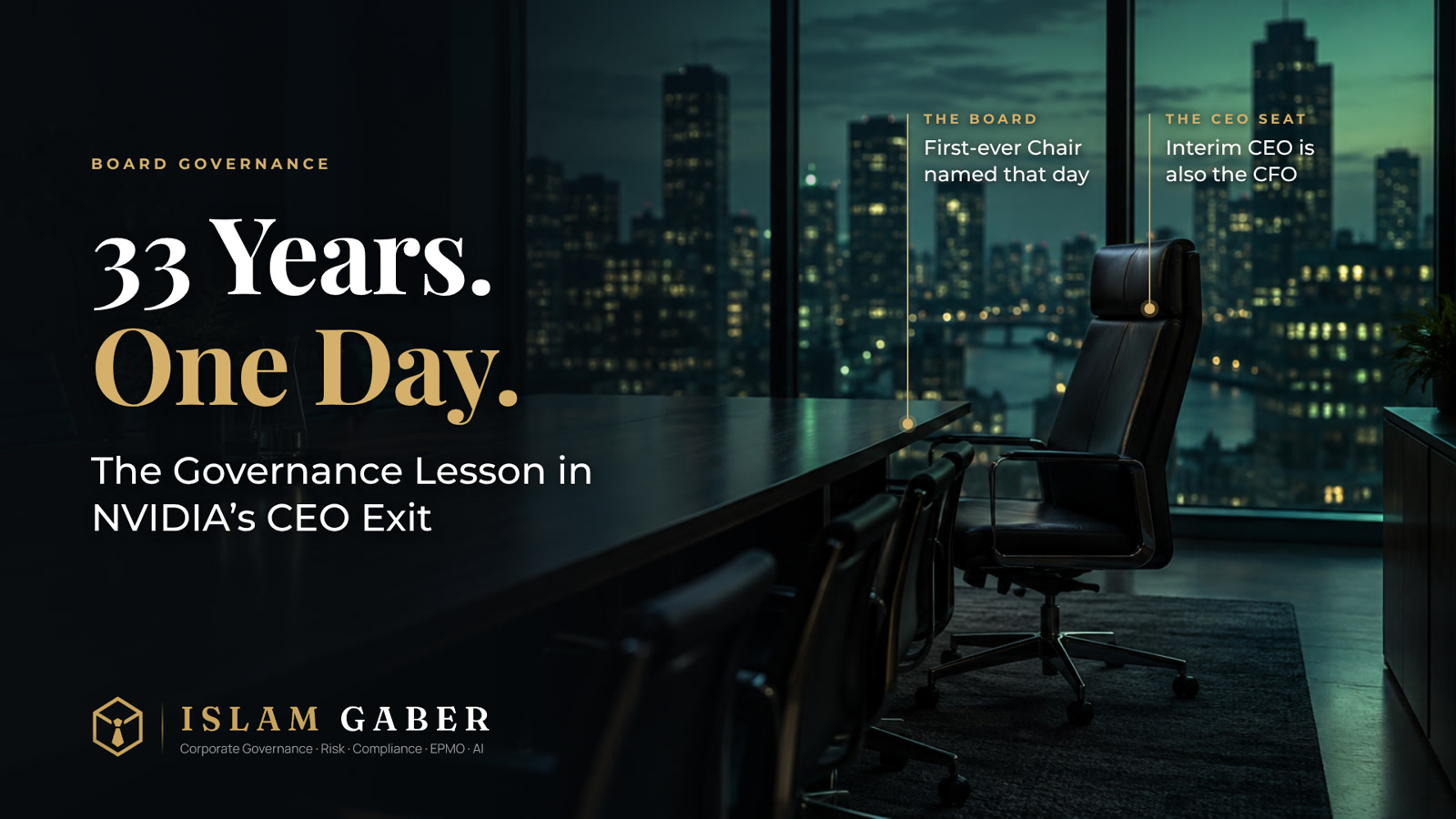
If the most important person in your company left tonight, who would be running it tomorrow morning?
For thirty-three years, that question had an obvious answer at Nvidia. Jensen Huang co-founded the company in 1993 and led it from a struggling graphics-chip start-up to the centre of the global AI economy. He was the strategy, the culture and the public face of the business.
On 12 November 2026, after days of public reporting about his personal relationships and a review by the board, Nvidia announced that he had resigned as President, Chief Executive Officer and director, effective immediately. The company gave no reason. It thanked him for his "immeasurable contributions" to the company and the industry.
The personal side of this story belongs to the people involved. The governance side belongs to every board, because on that single day the company had to answer the question above in public, in real time, and with the whole market watching.
What One Day Revealed
Read the board's announcement closely, and you will see that most of it did not describe what happened. It described what had to be created.
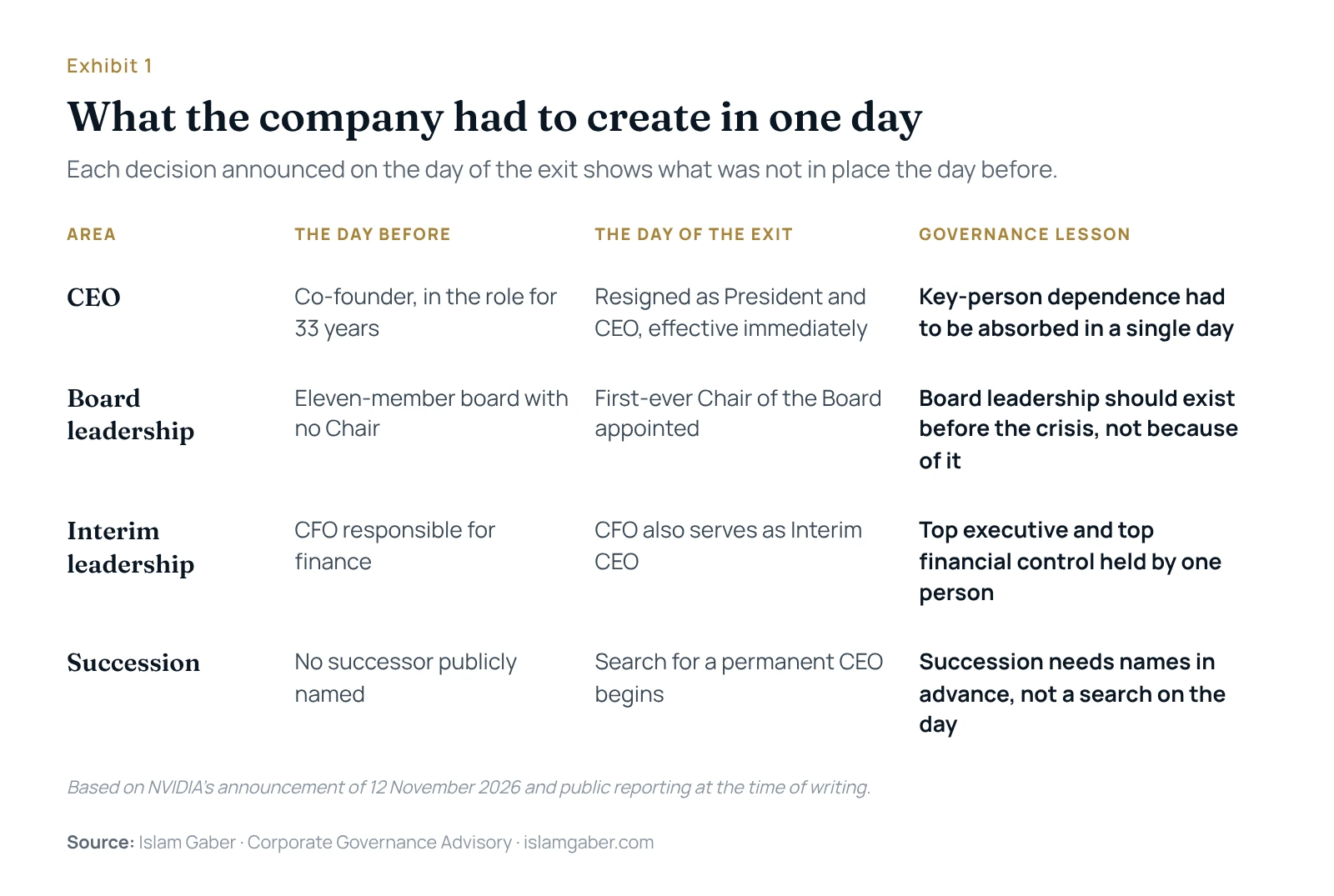
An eleven-member board that had operated for thirty-three years without a Chair appointed its first-ever Chair. The Chief Financial Officer was asked to serve as Interim CEO while keeping her role as CFO. And the board announced the start of a search for a permanent CEO. According to media reports, the share price fell by as much as 16% during the trading day before recovering part of the loss.
Each of those decisions was sensible, and the board deserves credit for acting quickly and decisively. But each one also answers a question about the day before: there was no Chair, no successor ready to step in, and no way to separate the company from the person who had led it for three decades.
That raises the real question: how does one of the best-run, most valuable companies in the world arrive at that point?
Governance Debt
The answer is a concept every founder-led company should understand: governance debt.
Every time a company postpones a governance decision because things are going well, it borrows from the future. "We will separate the roles later." "Succession can wait until the time comes." "The rules are clear, and he is the founder." "The dependence on him is fine; it is working." Each of these is a small, reasonable loan. None of them feels urgent, because the results are strong and the founder is present.
Like any debt, it accumulates quietly, and like any debt, it is eventually called in. The difference is that governance debt is never called in at a convenient moment. It is called in during a crisis, all at once, and in public: the Chair, the successor, the rules and the dependence must all be resolved on the same day, by people who are under the greatest possible pressure.
Success does not reduce governance debt. It hides it. The longer and more extraordinary the run of success, the larger the debt can grow without anyone noticing, because nobody questions a structure that keeps producing results.
The Day-After Test
There is a simple way to measure governance debt before a crisis measures it for you. Ask what would happen the morning after the company's most important person leaves without warning. A company that passes this Day-After Test has four things in place, long before it needs them. Each one corresponds to something that had to be created at Nvidia on the day of the exit.
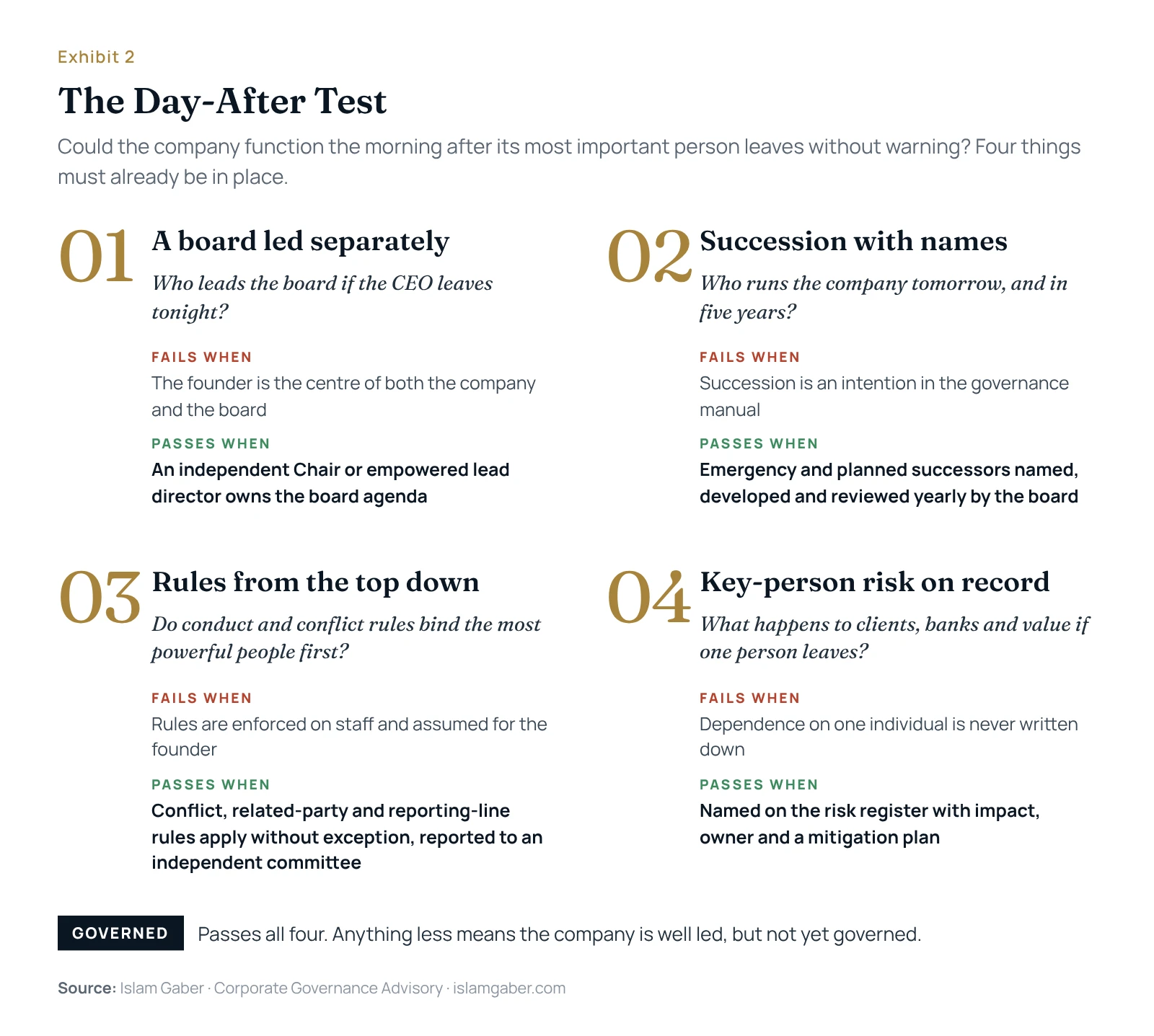
1. A board led separately — because the Chair had to be created on the day. When the same person is the centre of the company and the centre of the board that is supposed to oversee it, oversight depends on that person's willingness to be overseen. A separate Chair, or at minimum an empowered lead independent director who owns the board's agenda, gives the board its own centre of gravity. It should never have to invent one in the middle of a crisis.
2. Succession with names — because the interim leader had to hold two roles. When the CFO becomes Interim CEO, the company's top executive role and its top financial control sit with one person at the moment of greatest uncertainty. That is a reasonable emergency step, and it is also what happens when no successor is ready. A real succession plan is a list of critical roles, each with an emergency successor who can step in tomorrow and a planned successor being developed for the next three to five years, reviewed by the board every year.
3. Rules from the top down — because the crisis began at the top. Conflict-of-interest rules, related-party rules and rules on personal relationships within reporting lines exist in almost every company. They matter most for the people at the very top, who hold the most power and face the fewest checks. A code of conduct that is enforced on the staff and assumed for the founder is a hierarchy, and sooner or later it is tested at the level where it was never applied.
4. Key-person risk on record — because the market priced it in a single day. When a share price can fall sharply on the departure of one individual, the dependence was always a business risk. It simply had not been written down. Key-person risk belongs on the risk register with a name, an estimated impact on clients, financing, regulators and value, an owner, and a mitigation plan: documented relationships, delegated authorities and a visible second line of leadership.
A company that passes all four tests is governed. A company that fails any of them is well led, and is carrying governance debt it has not yet been asked to repay.
Now Apply It to a Family Group
Nvidia had a board of experienced independent directors, a strong executive team, a global brand and one of the strongest balance sheets in the world. It still had to rebuild key parts of its governance in a single day. Most founder-led companies have none of those buffers.
Consider an illustrative family-owned group in our region. Revenue is SAR 3 billion. The founder built the business over twenty-five years; he chairs the board and runs the company. The board has five members: the founder, two of his sons and two long-time friends. Five clients generate 65% of revenue, and every one of those relationships is managed personally by the founder. The group's SAR 1.2 billion of bank facilities include several backed by his personal guarantee. The senior team reports directly to him.
Now run the Day-After Test.
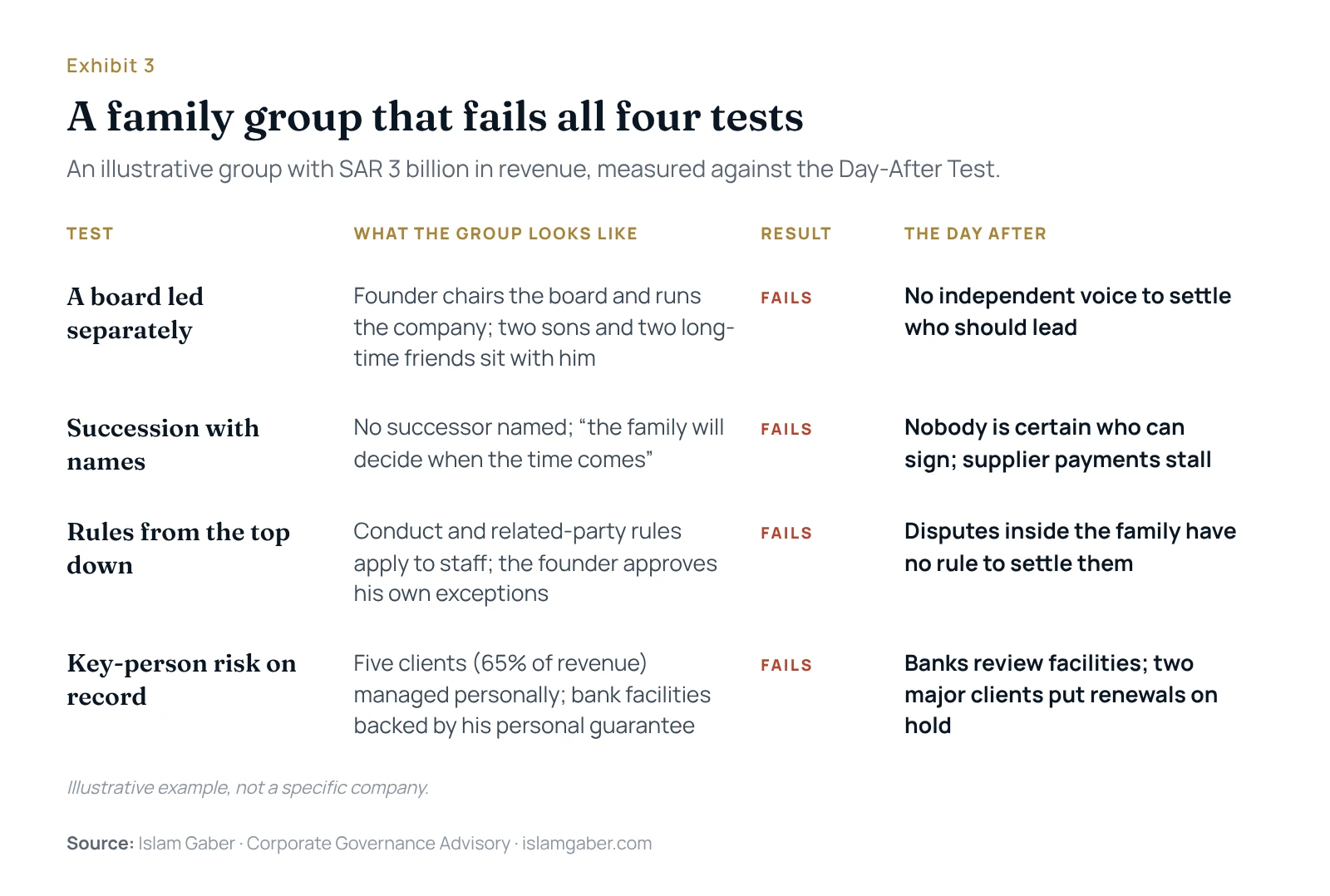
The group fails all four tests. And when the founder is suddenly unable to continue, through illness, a dispute or simply time, the consequences follow quickly. Nobody is certain who can sign, so supplier payments stall. The banks ask to review facilities that depended on a personal guarantee. Two of the five major clients put contract renewals on hold until they know who they will be dealing with. The family disagrees about who should lead, and the board has no independent voice to resolve it.
None of these problems is caused by the founder's departure. Every one of them is governance debt, built up over twenty-five years of success and called in within a few weeks.
If it took Nvidia a day to build what was missing, the honest question for every owner is how long it would take their own company, and how much value would be lost while it does.
Why the Founder Benefits Most
Founders often experience these measures as a loss of control, or as a sign of distrust. In practice, they protect the founder more than anyone else.
A separate Chair protects the founder from decisions that nobody challenged. A succession plan protects the founder's legacy from being decided in a rushed, public crisis. Rules applied at the top protect the founder from situations that can undo decades of work in a week. And a documented map of key-person dependence protects the value the founder created, for the family, the shareholders and the employees.
Governance does not reduce the founder's role. It makes sure the founder's work outlives the founder's presence.
A 100-Day Plan to Pay Down Governance Debt
None of this requires a crisis to begin. It requires a decision, taken in a calm period.
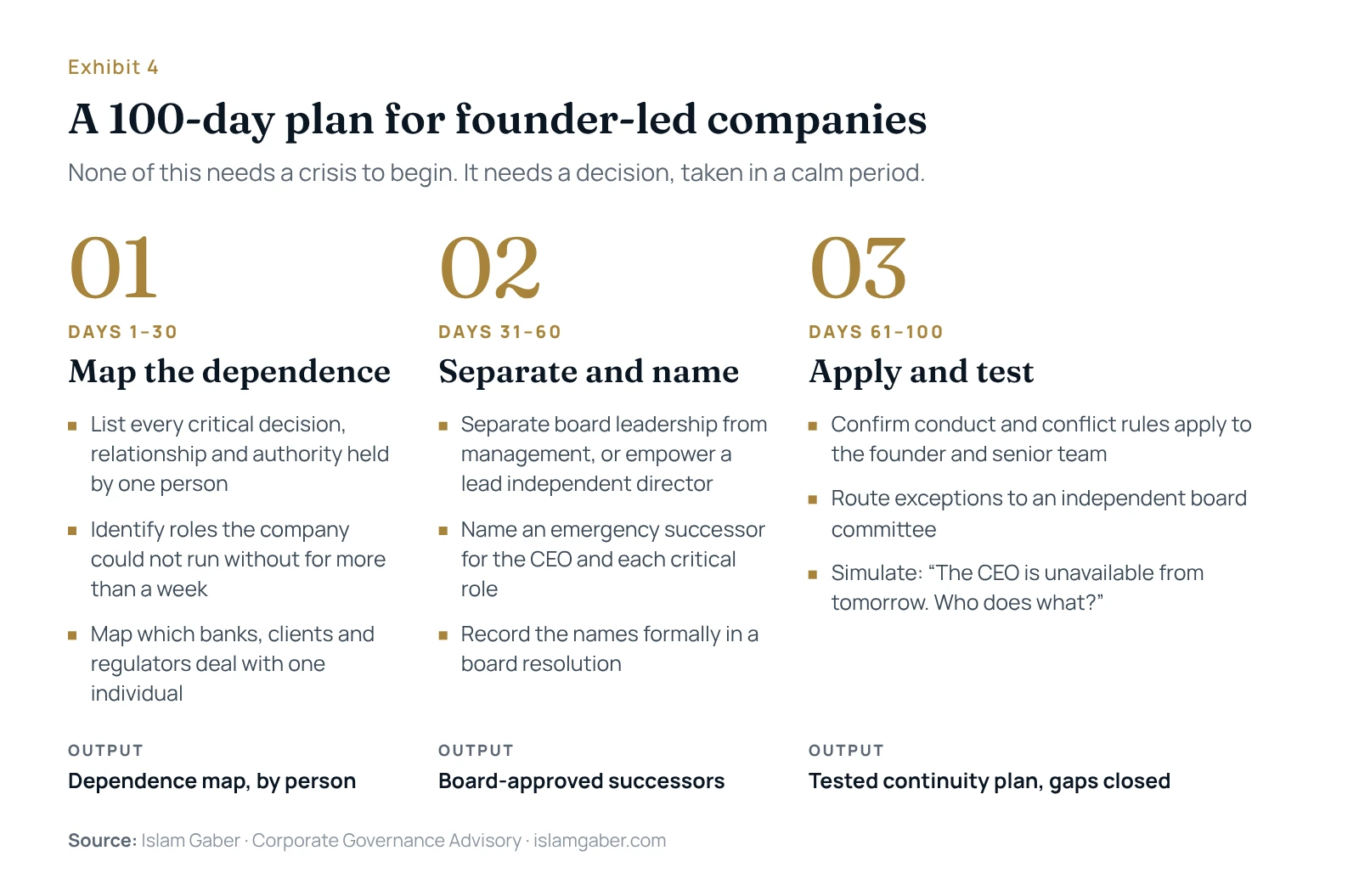
- Days 1–30: Map the dependence. List every critical decision, relationship and authority that sits with one person. Identify the roles the company could not operate without for more than a week, and the banks, clients and regulators that deal with one individual rather than with the company.
- Days 31–60: Separate and name. Separate the leadership of the board from the leadership of management, or appoint an empowered lead independent director. Name an emergency successor for the CEO and for each critical role, and record those names formally in a board resolution.
- Days 61–100: Apply and test. Confirm in writing that conduct, conflict-of-interest and related-party rules apply to the founder and the senior team without exception, with exceptions reported to an independent board committee. Then run a simple simulation, "The CEO is unavailable from tomorrow. Who does what?", and close every gap it exposes.
Questions Every Owner Should Ask
- "If our CEO left tonight, who would sign, who would lead and who would decide tomorrow morning, and is that written anywhere?"
- "Who leads our board, and could that person challenge the CEO without risking their seat?"
- "When did the board last review our succession plan, and does it contain names?"
- "Do our conduct and conflict-of-interest rules apply to the people at the top in practice, or only on paper?"
- "Which of our banks, clients and regulators deal with the company, and which deal only with one person?"
If the answers depend on one individual, the company is led well. It is not yet governed.
Measuring It
The RASEKH™ Governance Index assesses board structure, succession readiness, conduct and conflict-of-interest controls, and risk management as governance domains in their own right. Across 15 domains and up to 152 indicators, each backed by evidence, it shows owners how much governance debt their company is carrying, and which part to pay down first.
The Bottom Line
Thirty-three years of building. One day to rebuild what was missing.
Nvidia’s board acted quickly when it was tested, and it had the resources to absorb the shock. Most companies would not. The lesson is to pay down governance debt during the years when the leader is succeeding, because that is when it is cheapest, quietest and entirely within your control. A company that does this can lose its leader without losing its way.
Facts in this article reflect Nvidia’s official announcement and public reporting as of 13 November 2026, and the story is still developing. The article examines the governance structure, not the person.