

In every company without clear rules, someone is quietly winning.
Every governance project meets resistance. Most of it is honest. People worry about delays, extra forms, and losing the flexibility that helped the company grow.
But there is a second kind of resistance that owners rarely name out loud. It comes from people whose influence depends on the fact that nothing is written down. They know how things really work. They know which approvals can be skipped, which numbers need "context", and which conversations reach the owner. For them, ambiguity is not a problem to be solved. It is their position.
This article is about that second kind — how to see it, why it is so effective, and how to introduce governance without turning it into a war.
A Scenario Most Owners Will Recognize
Consider a pattern that plays out in many growing companies. A business that started with twenty people now has three hundred. One long-serving operations manager has been there from the start. Every significant purchase goes through him, although no policy says so. Suppliers call him directly. When the owner asks how a project is going, the answer comes from this manager, not from the project team.
Then the owner announces a delegation of authority matrix and a monthly reporting pack. Within weeks, the project slows down. Each draft "needs more work". Departments are "too busy this quarter". The matrix is finally approved — and then quietly ignored, because everyone knows the real approval still runs through the same desk.
Nobody broke a rule. There were no rules to break. That is exactly the point.
Where Informal Power Comes From
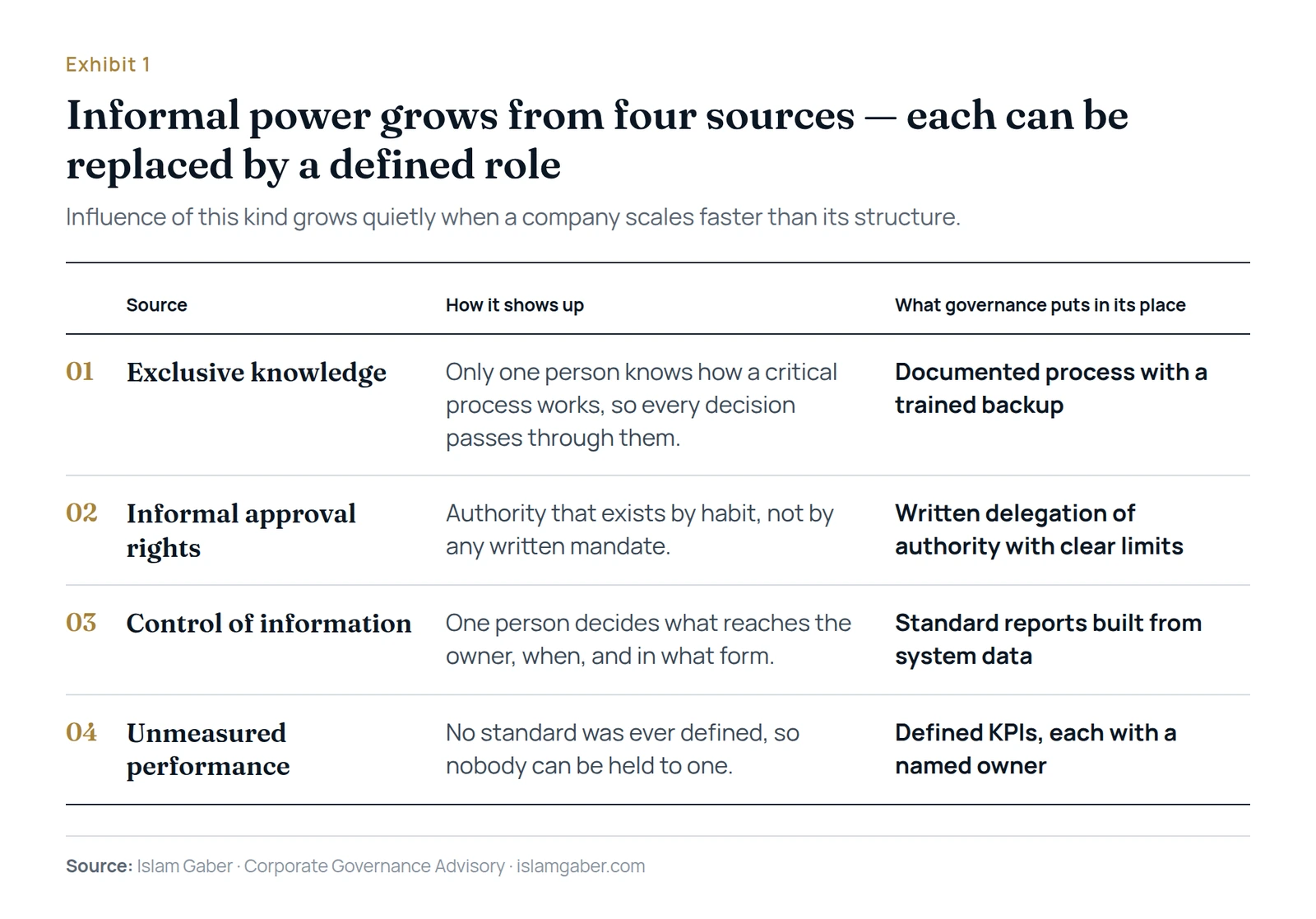
Informal power grows naturally when a company scales faster than its structure. It usually comes from four sources:
- Exclusive knowledge — only one person knows how a critical process works, so every decision must pass through them
- Informal approval rights — authority that exists by habit, not by any written mandate
- Control of information — deciding what reaches the owner, when, and in what form
- Unmeasured performance — when no standard was ever defined, nobody can be held to one
None of this requires bad intent. But once it exists, governance threatens it directly — because governance turns personal influence into defined roles that everyone can see, question, and measure.
Why Owners Tolerate It
Here is the uncomfortable part: the owner is often the last to see this — and sometimes the one who built it.
Informal power is convenient. One trusted person who "handles everything" saves the owner time. Loyalty feels safer than process. And challenging someone who has been there since the beginning feels like disrupting something that works.
So the arrangement survives, not because anyone defends it openly, but because questioning it feels ungrateful. That silence is what turns a convenience into a structural weakness.
What the Chaos Really Costs
Ambiguity is not free. It is paid for every day, usually without appearing on any report:
- Slower decisions — everything waits for one desk, one signature, one person's availability
- Key-person risk — if that person leaves, falls ill, or is pulled into a dispute, the process stops
- Invisible leakage — without defined approvals and records, nobody can say what was paid, why, and to whom
- Blocked talent — capable managers leave when real authority sits with someone outside the organization chart
- Lower company value — investors, lenders, and acquirers discount businesses that depend on a few individuals rather than on a system
The Five Faces of Resistance
Resistance to governance almost never looks like opposition. It looks like reasonable concern. The skill is learning to hear what each argument may be protecting.
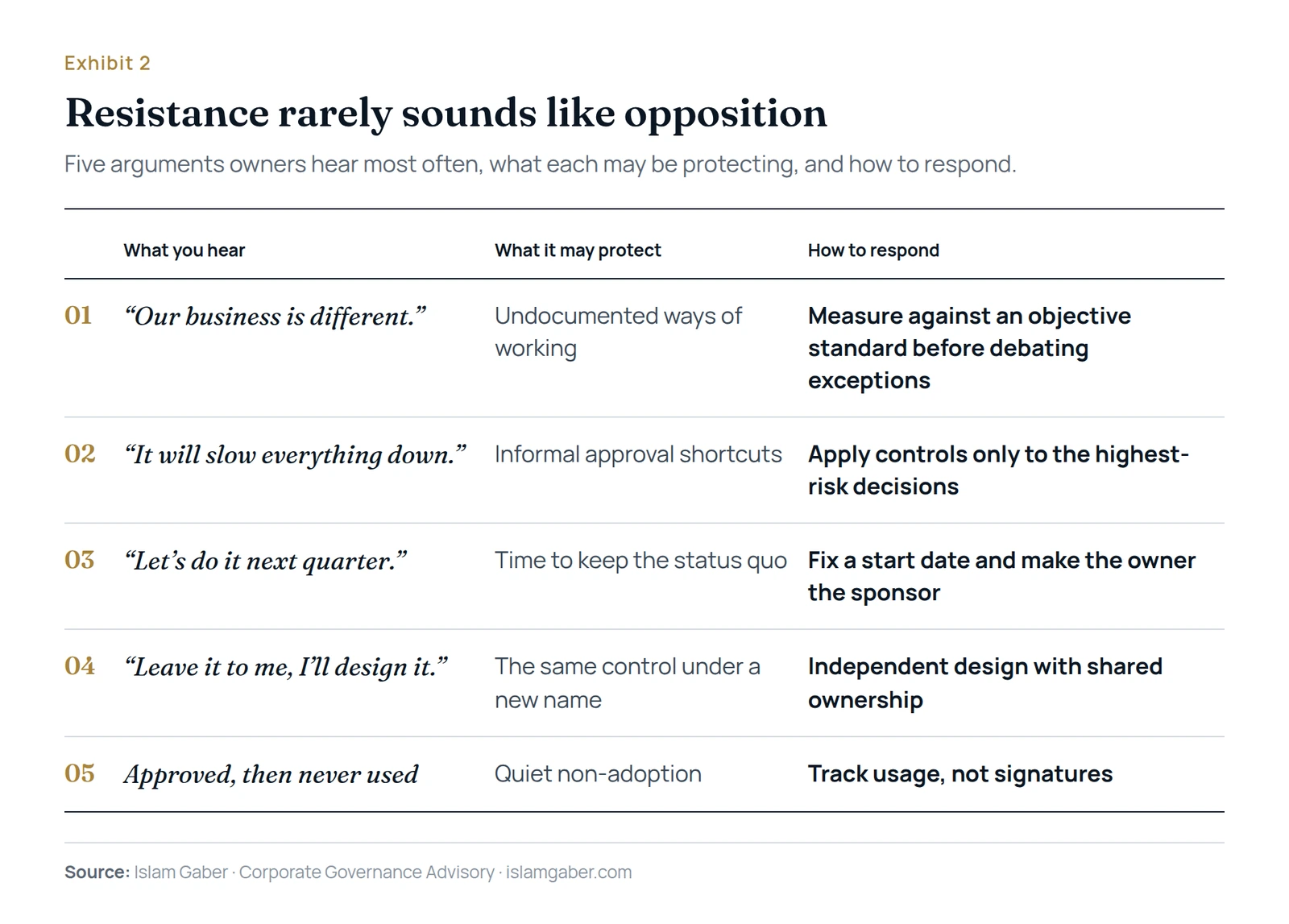
- "Our business is different." Every business is different. That is precisely why it should be measured against an objective standard, not exempted from one.
- "It will slow everything down." Good governance targets the riskiest decisions, not every decision. If someone objects to controls on high-value payments, ask why those payments in particular.
- "Let's do it next quarter." Delay is the most effective form of resistance, because it never has to say no.
- "Leave it to me — I'll design it." The person who controls the current process offers to design the new one. The result is the same control under a new name.
- Approved, then never used. The policy is signed in the board meeting and abandoned in practice. This is the most common outcome, and the hardest to see.
Resistance Is Data, Not a Verdict
This is not an argument against long-serving employees. They often carry the company's history and its relationships, and many of them are among its strongest assets.
But the pattern of resistance is valuable information. The process someone fights hardest to keep undocumented is usually the one that most needs documenting. Treat resistance as a map of where governance matters most — not as an accusation against the people involved.
How to Spot It in One Week
Owners do not need a consultant to see whether chaos is protecting someone. Five practical checks are enough to start:
- Trace the last twenty significant decisions. For each one, compare who actually approved it with who should have, according to any written authority.
- List the processes that only one person understands. Ask department heads: "If this person disappeared tomorrow, what would stop?"
- Ask for the documents. Request the written procedure for purchasing, payments, and hiring. Note which ones do not exist.
- Talk to the second line. Meet managers one level below the trusted circle, alone, and ask what slows them down.
- Review the last approved policy. Check whether it is actually used — and who was responsible for implementing it.
A 90-Day Rollout That Avoids a Turf War
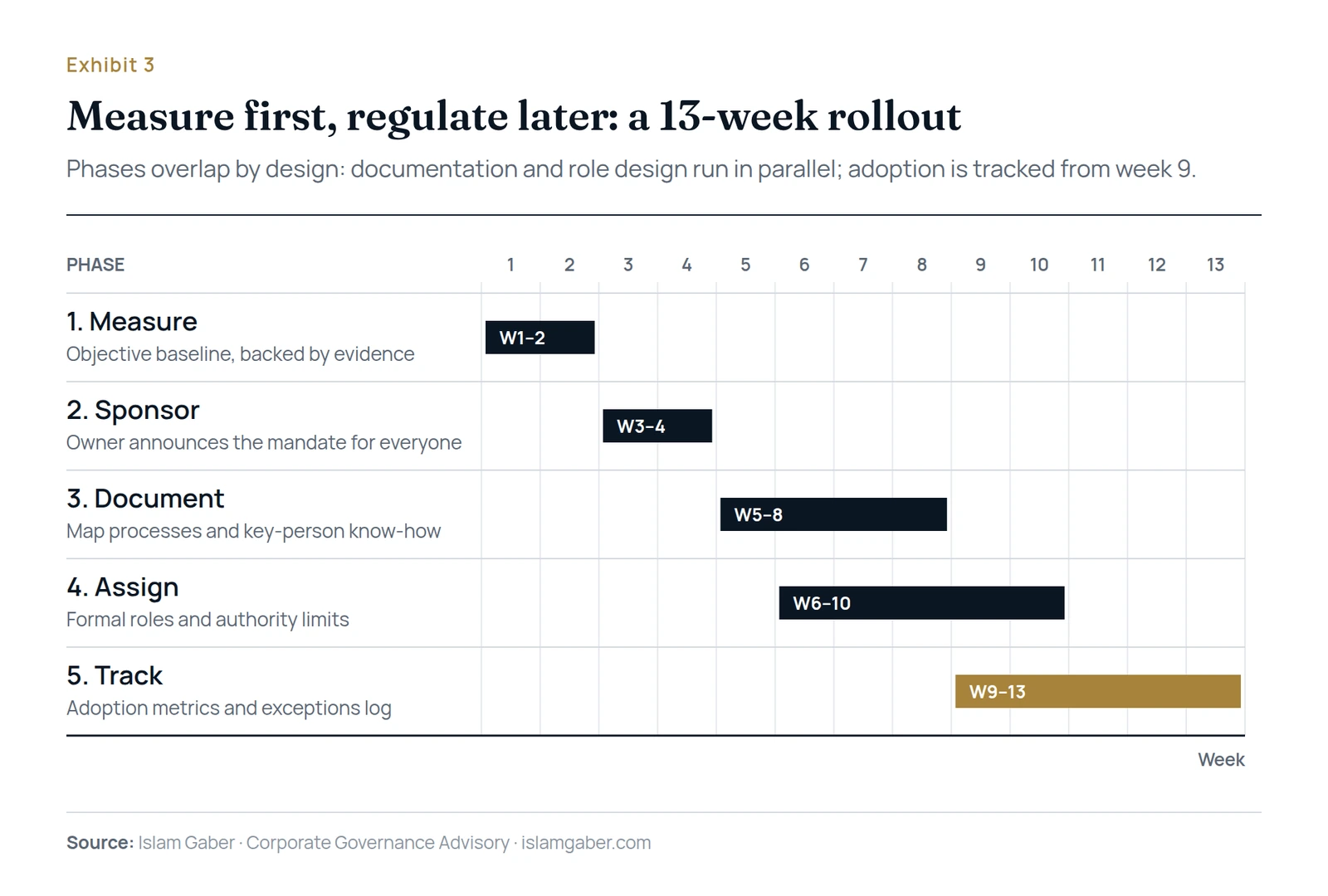
Weeks 1–2: Measure before you regulate. Start with an objective assessment of where the organization stands. When gaps are shown with evidence, the conversation shifts from "who is right" to "what the facts say" — and nobody has to defend their territory.
Weeks 3–4: Make the owner the visible sponsor. Governance without the owner's public backing becomes optional. The owner should announce the mandate, explain why it matters, and make clear that it applies to everyone — including the people closest to them.
Weeks 5–8: Document knowledge, don't remove people. Map the critical processes and capture what lives only in individual heads. The goal is to make expertise shared, not to replace the experts.
Weeks 6–10: Give influential people a formal role. Most capable people prefer real authority with clear limits over informal power that can be questioned at any time. Offer it.
Weeks 9–13: Track adoption, not approval. A signed policy proves nothing. Measure usage: how many decisions followed the new authority matrix, how many exceptions were requested, and who requested them.
Questions Every Owner Should Ask This Month
- Which decisions in my company depend on one specific person?
- If that person were absent for a month, what would stop?
- Who holds authority that is not written down anywhere?
- Which governance initiative did we approve and then never use — and who was responsible for it?
Measuring It
The RASEKH™ Governance Index gives owners an objective baseline across 15 governance domains — including authority, decision-making, and reporting — with every score backed by named evidence. It replaces opinions about who is right with facts about where the organization stands, which is exactly what defuses this kind of resistance.
The Bottom Line
Chaos is never neutral. Someone always benefits from it. Before asking why governance is so hard to implement, ask the more useful question: who would lose influence if everything in this company were clear?