
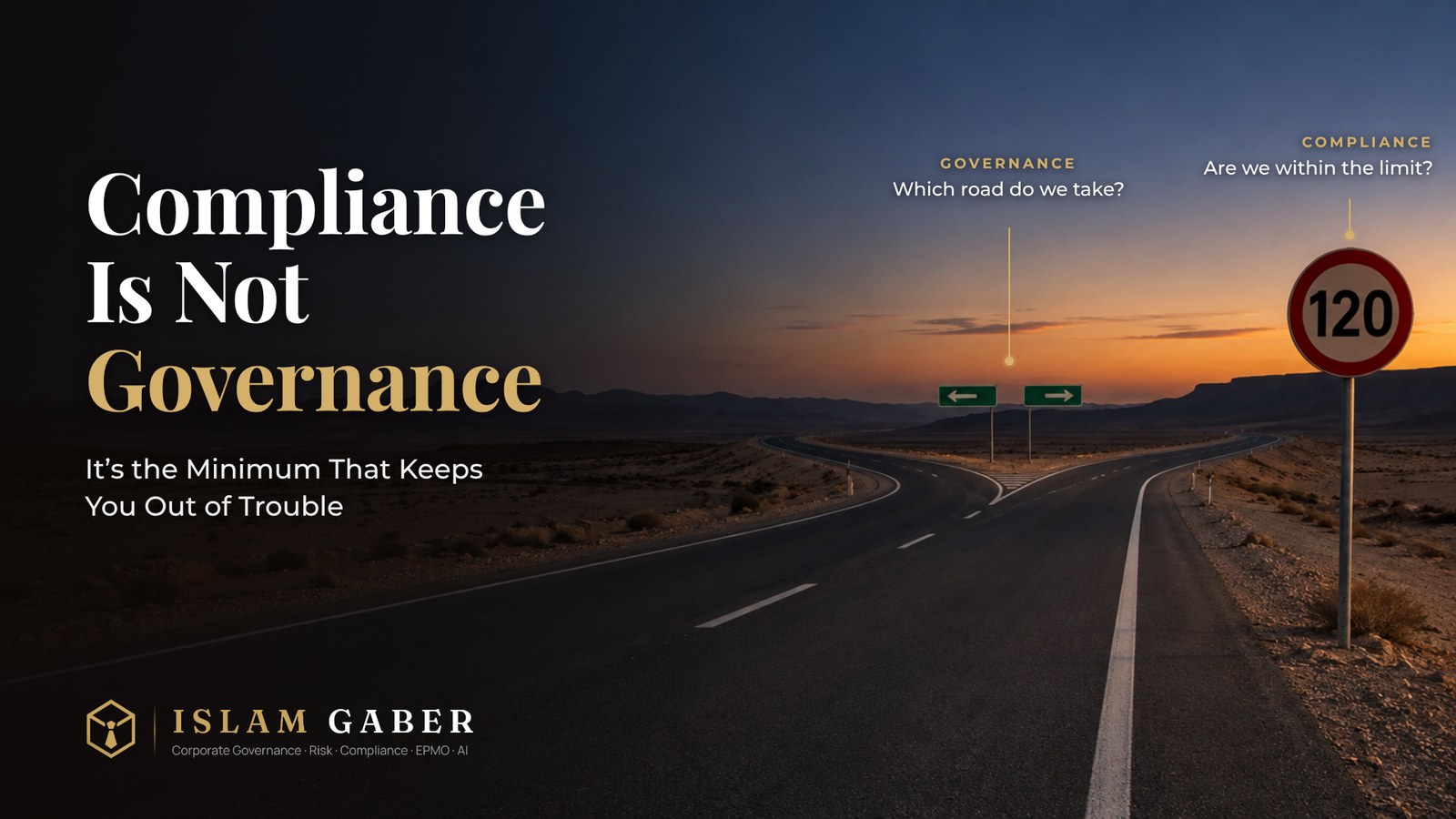
Passing every audit is not the same as being well governed.
Many companies in the region are proud of their compliance record, and rightly so. The licences are current. The financial statements are audited without qualification. The policies were approved by the board. Every regulatory deadline is met, and every inspection ends without a finding.
And yet some of these same companies are caught off guard by a cash crisis nobody saw coming, a strategic project that runs two years late, or a related-party contract that quietly cost millions. Every box was ticked. Nothing was prevented.
The reason is simple, and it is one of the most common misunderstandings in boardrooms: compliance and governance answer two different questions. A company can be excellent at the first and still be weak at the second, and nothing in its audit file will warn it.
A Familiar Story
Consider a pattern seen in many growing companies. A business invests seriously in compliance. It appoints a respected external audit firm, hires a compliance officer, and adopts a full library of approved policies. The board meets four times a year, receives thick reports, and approves everything on the agenda.
Then three things happen in the same year.
- A major expansion overruns its budget by a wide margin. The business case was approved, but nobody had defined the point at which the project should come back to the board.
- A key customer contract turns out to carry penalties nobody had priced. It was signed within the authority of the manager who signed it, but nobody had asked whether that authority was appropriate for a contract of that size and risk.
- The company discovers that one of its largest suppliers is partly owned by a senior manager. No law was broken. The relationship was simply never declared, because nobody was ever asked to declare it.
None of these was a compliance failure. No regulation was breached, and no regulator was involved. They were governance failures: decisions taken without the right information, the right challenge, or the right authority.
Two Different Questions
The clearest way to see the difference is to ask what each discipline is actually for.
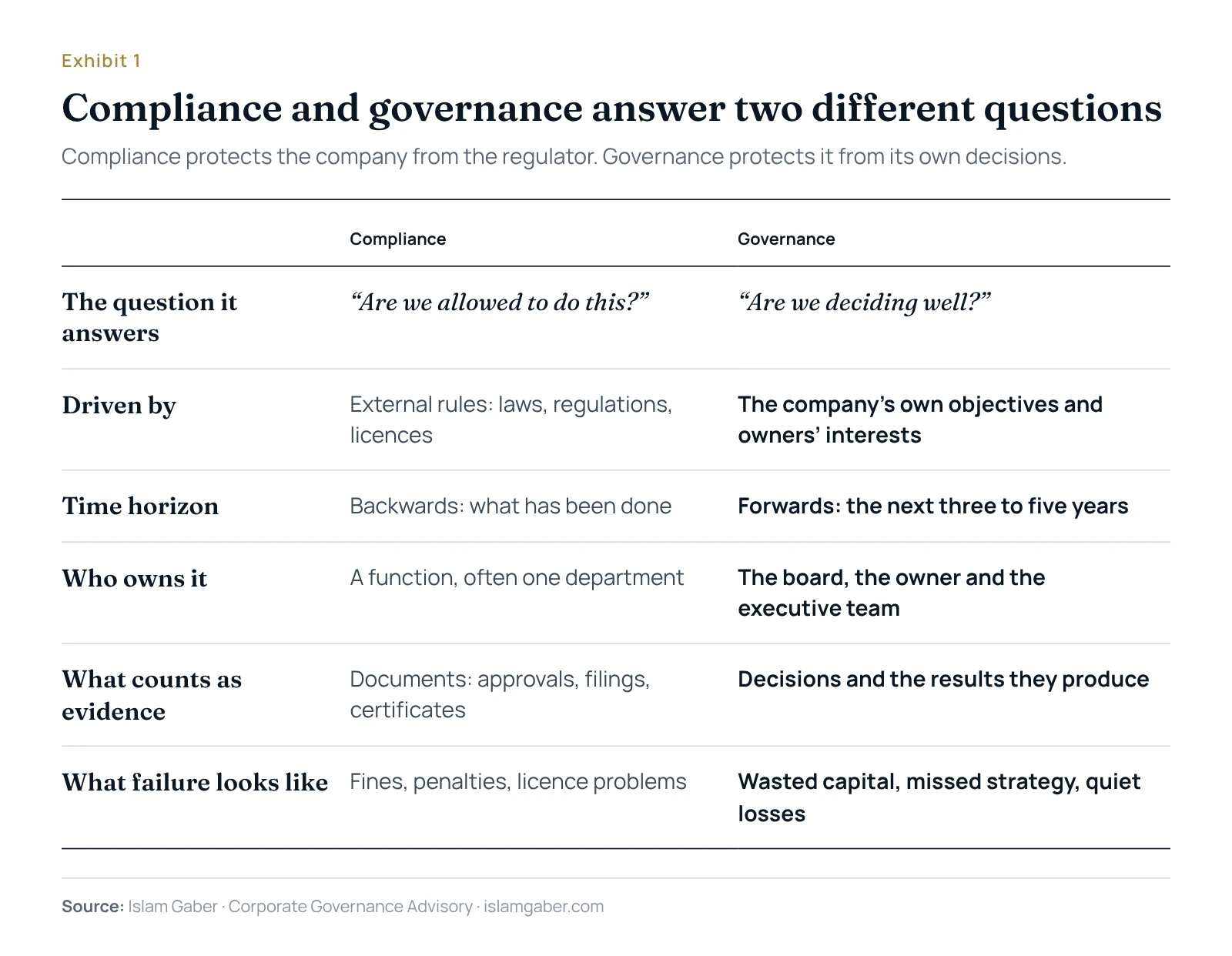
- Compliance asks: "Are we allowed to do this?" It is driven by external rules — laws, regulations, licence conditions and standards. It looks backwards, at what has already been done, and its evidence is documents: approvals, filings, certificates and signed policies.
- Governance asks: "Are we deciding well?" It is driven by the company's own objectives and by the interests of its owners. It looks forward, at the decisions that will shape the next three to five years, and its evidence is the quality of those decisions and the results they produce.
Compliance is necessary. A company that breaks the rules will not survive long enough to worry about governance. But compliance is the floor, not the ceiling. It protects a company from the regulator. It does not protect a company from its own decisions.
Why Capable Companies Stop at Compliance
Companies that stop at compliance are rarely careless. More often, they stop there for reasons that make sense at the time:
- Compliance is easy to measure. A licence is either valid or expired. A filing is either on time or late. Governance quality is harder to see, so it receives less attention.
- The pressure is external. Regulators, banks and auditors ask for compliance evidence. Nobody outside the company asks whether the board challenged a weak business case.
- It can be delegated to a department. Compliance fits neatly into one function with one manager. Governance cannot be delegated in the same way, because it sits with the board, the owner and the executive team.
- Audits reward documents. An inspection checks that a policy exists and was approved. It rarely checks whether anyone used it to make a decision.
The result is a company that looks well governed from the outside, and often believes it is, while the most important decisions are still made informally.
Four Signs a Company Confuses the Two
- Policies are written for the regulator, not for the business. They exist to pass an inspection, so managers do not open them when making daily decisions. Ask a department head which policy guided their last major decision, and the answer is often a pause.
- Board time goes to approvals, not to decisions. Most of the meeting is spent noting reports and approving items that were effectively settled elsewhere. Very little time is left for strategy, risk and the choices that will define the company's future.
- Risk is reviewed once a year. The risk register is updated before the audit and left untouched until the next one. It records risks; it does not change decisions.
- Performance numbers have no owner. Reports are produced on time and in detail, but nobody is clearly accountable for acting on what they show. The same variances appear month after month.
Where Compliance-Only Companies Get Hurt
The most expensive mistakes rarely happen where the rules are clear. They happen in areas where the law says little and judgement decides everything.
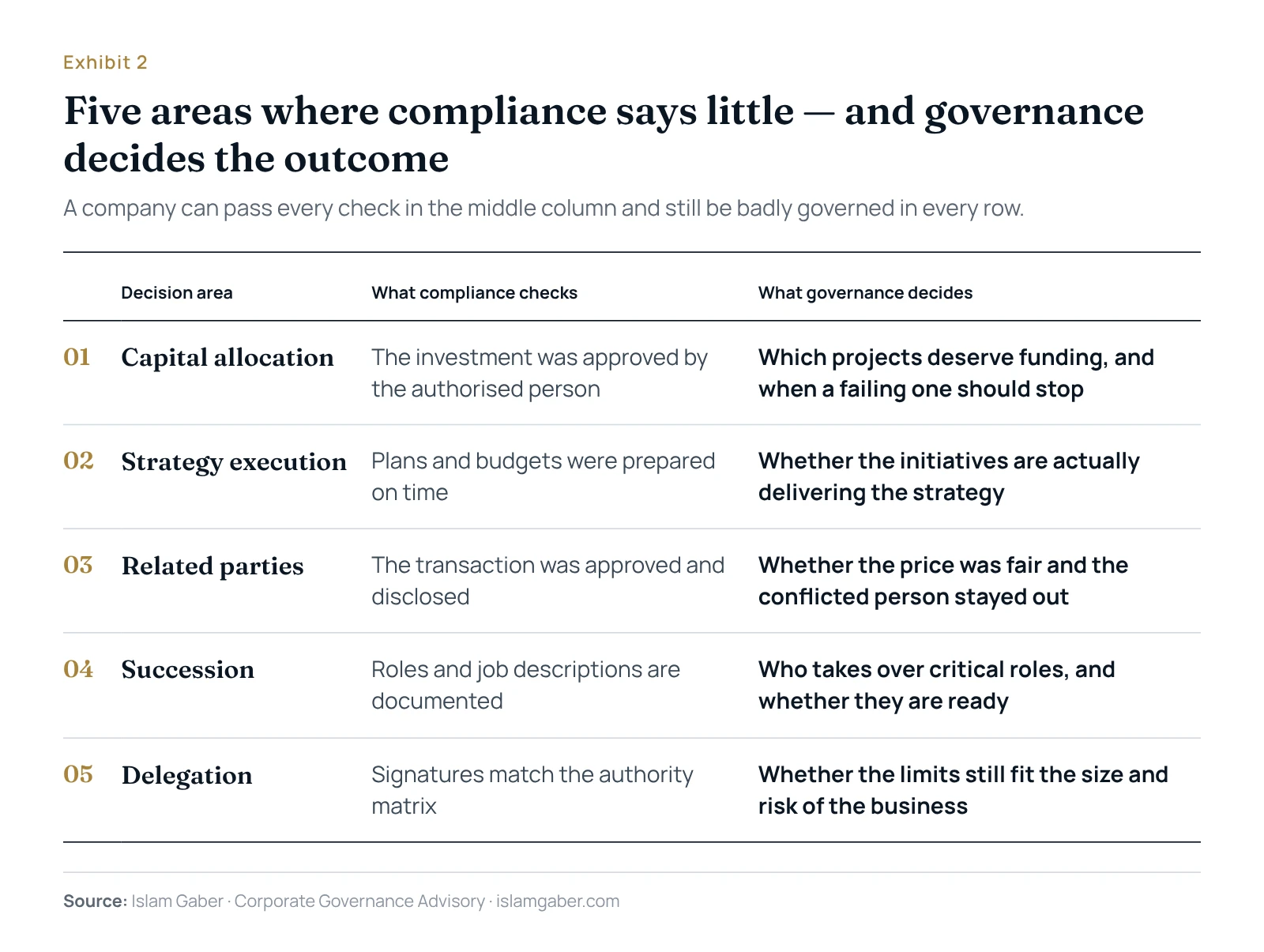
- Capital allocation — which projects get funded, how much, and when to stop one that is failing. The law does not tell a company which investments are wise.
- Strategy execution — whether the portfolio of initiatives is actually delivering the plan, or simply consuming budget.
- Related parties — transactions that may be legal and properly approved on paper, but are not at fair value.
- Succession — who takes over critical roles, from the CEO to the one person who understands the numbers, and whether anyone has prepared them.
- Delegation — who can commit the company, to what amount, and whether those limits still match the size and risk of the business today.
A company can be fully compliant in all five areas and still be badly governed in every one of them.
The Governance Maturity Ladder
Most companies move through recognisable stages. The goal is not to jump to the top in one step, but to know honestly where the company stands and what the next level requires.
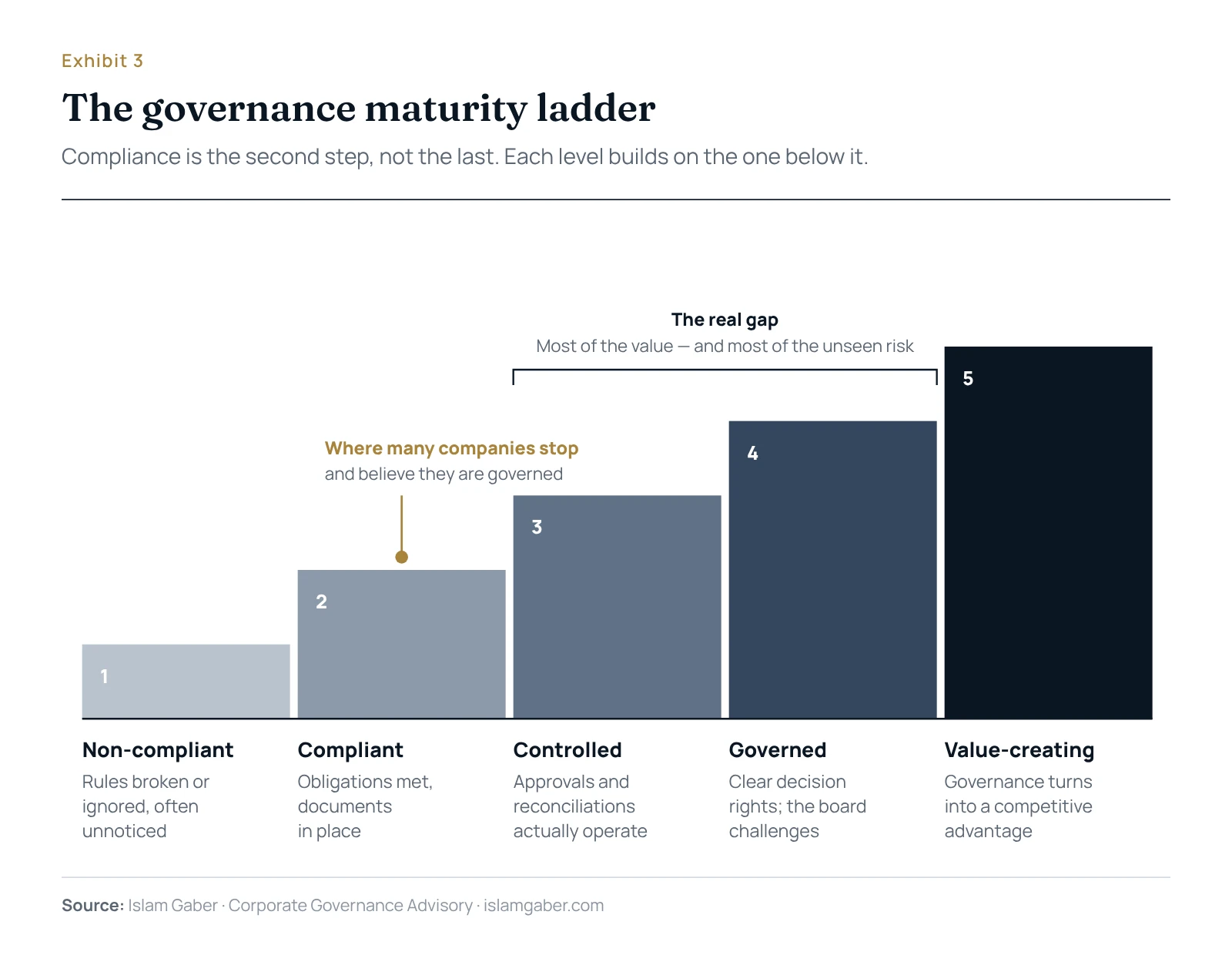
- Non-compliant — rules are broken or ignored, often without anyone knowing.
- Compliant — the company meets its legal and regulatory obligations, and has the documents to prove it.
- Controlled — key processes have working controls: approvals, segregation of duties and reconciliations that actually operate.
- Governed — decision rights are clear, the board challenges and decides, and risk shapes choices before they are made.
- Value-creating — governance is part of how the company competes: it allocates capital better, executes strategy faster, and earns the confidence of lenders, investors and partners.
Many companies that describe themselves as well governed sit at the second step. The distance between "compliant" and "governed" is where most of the value, and most of the unseen risk, lies.
From Compliance to Governance: Five Practical Moves
- Define decision rights. A clear delegation of authority states who decides what, up to which limit, and who must be consulted first. It should cover not only spending, but also contracts, hiring, pricing, write-offs and exceptions — and it should be enforced in the company's systems, not only written in a manual.
- Redesign the board agenda. Spend at least half of every meeting on forward-looking decisions: strategy, major investments, key risks and leadership. Reports should be read before the meeting, not presented in it. A useful test: after each meeting, list the decisions the board actually made.
- Set a risk appetite. Agree in writing how much risk the company is willing to take in each major area — concentration on one customer, leverage, project size, new markets. Management then knows where the limits are, and the board knows when a proposal should come back to it.
- Build decision-grade information. Board and management reports should show the few numbers that require a decision, with an owner and a deadline beside each one. Information that does not lead to a decision or an action is noise.
- Create independent challenge. Independent directors, an active audit committee and a strong internal audit function exist to question management, not to approve it. A board that has never rejected or materially changed a proposal is probably not challenging enough.
None of these moves requires a large programme. Each can start within one quarter, and each produces visible evidence of whether it is working.
Questions Every Owner Should Ask
- When did our board last reject or substantially change a management proposal?
- Which of our policies would a manager actually open before making a decision?
- Who decides when to stop a project that is failing, and has it ever happened?
- Are our approval limits still right for the size and risk of the business we run today?
- If our compliance record is perfect, why are we still being surprised?
Measuring It
The RASEKH™ Governance Index looks beyond whether a policy exists to whether it is practised. Across 15 governance domains and up to 128 indicators, every score is backed by named evidence, showing owners the difference between a company that is compliant on paper and one that is governed in practice — and exactly which step of the ladder each domain has reached.
The Bottom Line
Compliance keeps you out of trouble. Governance keeps you in business. A company that stops at compliance has protected itself from the regulator, but not from its own decisions — and in the long run, it is the decisions that determine whether the company grows, stalls or fails.