

Impact & Real-World Results
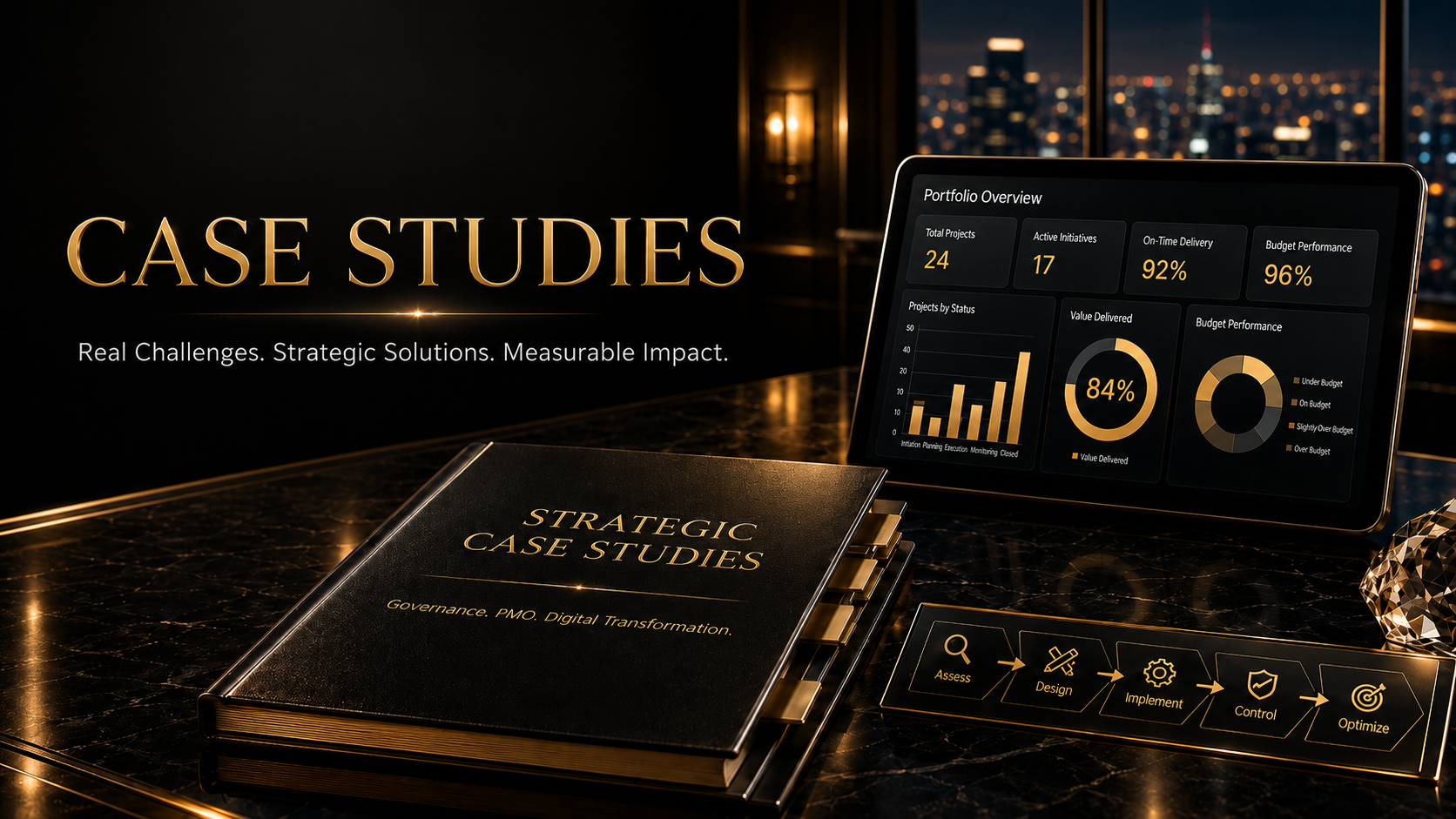
Exploring real-world transformations where complex project challenges were met with rigorous governance and digital innovation. These strategic case studies highlight measurable executive success, demonstrating how disciplined oversight directly translates to financial protection, recovered timelines, and operational excellence.
Governance & Cost Control Transformation for a Fit-Out Company
Sector: Fit-Out Projects | Scope: Governance & Financial Control | Duration: 3 Months
A mid-size fit-out contractor managing 8+ simultaneous fast-track projects was operating without structured financial controls. Budget overruns were reaching 20–30% per project, invoice approval cycles exceeded 45 days, and leadership had no consolidated view across the portfolio. Site and finance teams operated in silos, producing conflicting reports.
Designed and implemented a governance-driven project and financial control framework:
- Standardized cost tracking templates and cash flow monitoring across all active projects
- Integrated site, finance, and PMO reporting into a single weekly executive report
- Established tiered approval workflows and a formal authority control matrix
- Deployed executive dashboards providing real-time cost and collection status
- Reduced cost overruns by 32% within the first quarter of implementation
- Cut invoice approval cycles from 45 days to under 12 days
- Achieved 100% portfolio visibility at executive level for the first time
- Improved cash flow forecasting accuracy by 40%
Enterprise PMO & Governance Setup for a Construction Company
Sector: Construction & Infrastructure | Scope: Enterprise PMO | Duration: 6 Months
A growing construction company managing a multi-project portfolio of over SAR 800M had no centralized PMO. Each project operated independently with inconsistent methodologies, fragmented reporting, and no shared KPI framework. Executive decisions were reactive, driven by escalations rather than data.
Established a fully structured Enterprise PMO aligned with governance best practices:
- Defined PMO charter, structure, operating model, and staffing framework
- Implemented portfolio-level reporting system with unified dashboards
- Standardized planning, cost control, risk, and change management processes
- Introduced executive KPI scorecards with weekly and monthly reporting cadence
- Reduced project delays across the portfolio by 28%
- Improved executive decision speed by 40% through real-time portfolio visibility
- Standardized execution methodology across 12+ active projects
- Decreased reactive escalations by 60% within 6 months
Performance & Operational Control Optimization for an Industrial Company
Sector: Industrial & Manufacturing | Scope: Performance Governance | Duration: 3 Months
A manufacturing operation was producing below capacity with no formal performance measurement system in place. Resource utilization was estimated at under 65%, finance and operations teams produced separate often contradictory reports, and leadership had no mechanism to identify underperformance early.
Designed and deployed an integrated performance governance system:
- Developed a comprehensive KPI framework covering production, quality, cost, and HR dimensions
- Integrated financial and operational reporting into a unified monthly performance pack
- Implemented real-time production monitoring dashboards accessible to line managers and executives
- Optimized resource allocation processes using data-driven scheduling models
- Increased operational efficiency by 25% within two quarters
- Improved resource utilization from under 65% to 84%
- Reduced production reporting preparation time by 50%
- Enabled leadership to identify and respond to performance gaps 3× faster
Risk & Compliance Framework Implementation for an Oil & Gas Company
Sector: Oil & Gas | Scope: Enterprise Risk Management | Duration: 7 Months
An oil and gas operator faced escalating operational and regulatory compliance risks with no structured ERM framework in place. Risk identification was ad hoc, mitigation actions were undocumented, and there was no formal mechanism for monitoring regulatory compliance across business units. A single unmanaged risk event had previously resulted in significant financial and reputational exposure.
Implemented a comprehensive Enterprise Risk Management framework:
- Developed a risk register covering operational, financial, regulatory, and strategic risk categories
- Defined risk appetite thresholds and formal mitigation ownership at executive level
- Integrated risk status reporting into existing governance and board reporting cycles
- Established a compliance tracking system with automated escalation triggers
- Reduced high-exposure operational risks by 45% within the first 6 months
- Achieved full regulatory compliance documentation across all business units
- Enabled proactive risk identification — average lead time to mitigation improved by 3 weeks
- Strengthened board-level confidence in risk governance and reporting integrity
Digital Reporting Transformation for a Construction Group
Sector: Construction | Scope: Digital PMO & BI Transformation | Duration: 3 Months
A multi-project construction group was spending an estimated 40+ man-hours per week manually preparing project reports across finance, planning, and operations. Data was pulled from disconnected systems, leading to inconsistencies, version conflicts, and reporting delays of up to 2 weeks. Executives were making decisions based on outdated information.
Led end-to-end digital transformation of the reporting ecosystem:
- Implemented Power BI dashboards integrated with live project and financial data
- Connected ERP (SAP) with project scheduling and cost control systems
- Automated data collection, validation, and report generation workflows
- Centralized all project data into a single governed reporting platform
- Reduced reporting preparation time by 60% — from 40+ hours to under 16 hours per week
- Eliminated data inconsistencies across finance, planning, and operations
- Enabled real-time executive reporting replacing 2-week delayed cycles
- Improved decision-making speed by 35% as measured by leadership response time to variances
Organizational Restructuring & Governance Enhancement for an Industrial Group
Sector: Industrial & Multi-Business | Scope: Org Design & Governance | Duration: 3 Months
A diversified industrial group operating across 4 business units had grown without a structured governance model. Roles overlapped, reporting lines were unclear, and accountability gaps meant that decisions were either duplicated or fell through entirely. There was no formal authority matrix, and governance policies were largely undocumented.
Redesigned the organizational structure aligned with governance and strategic objectives:
- Conducted a full organizational diagnostic across all business units
- Defined clear roles, responsibilities, and a formal Delegation of Authority (DOA) matrix
- Rationalized reporting lines and spans of control to eliminate duplication
- Established governance policies, SOPs, and an internal communication framework
- Reduced decision-making bottlenecks by 40% through clear authority delegation
- Eliminated role duplication across 3 of 4 business units
- Achieved documented governance framework covering 100% of critical functions
- Improved cross-unit coordination and accountability visibility at board level
Digital Reporting Transformation - Construction Group
Sector: Construction | Scope: Digital PMO & BI Transformation | Duration: 3 Months
A multi project construction group was spending an estimated 40+ man-hours per week manually preparing project reports across finance, planning, and operations. Data was pulled from disconnected systems, leading to inconsistencies, version conflicts, and reporting delays of up to 2 weeks. Executives were making decisions based on outdated information.
Led end-to-end digital transformation of the reporting ecosystem:
- Implemented Power BI dashboards integrated with live project and financial data
- Connected ERP (SAP) with project scheduling and cost control systems
- Automated data collection, validation, and report generation workflows
- Centralized all project data into a single governed reporting platform
- Reduced reporting preparation time by 60% — from 40+ hours to under 16 hours per week
- Eliminated data inconsistencies across finance, planning, and operations
- Enabled real-time executive reporting replacing 2-week delayed cycles
- Improved decision-making speed by 35% as measured by leadership response time to variances