At the executive level, decisions are only as strong as the information behind them.
Many organizations invest heavily in dashboards and reporting systems yet still struggle with ineffective decision-making.
Why?
Because visibility alone is not enough.
What Most Executive Dashboards Provide
A typical executive dashboard focuses on:
- Project status indicators
- Financial summaries
- Performance metrics
On the surface, everything appears under control.
But the real challenge often lies beneath the surface.
The Hidden Problem
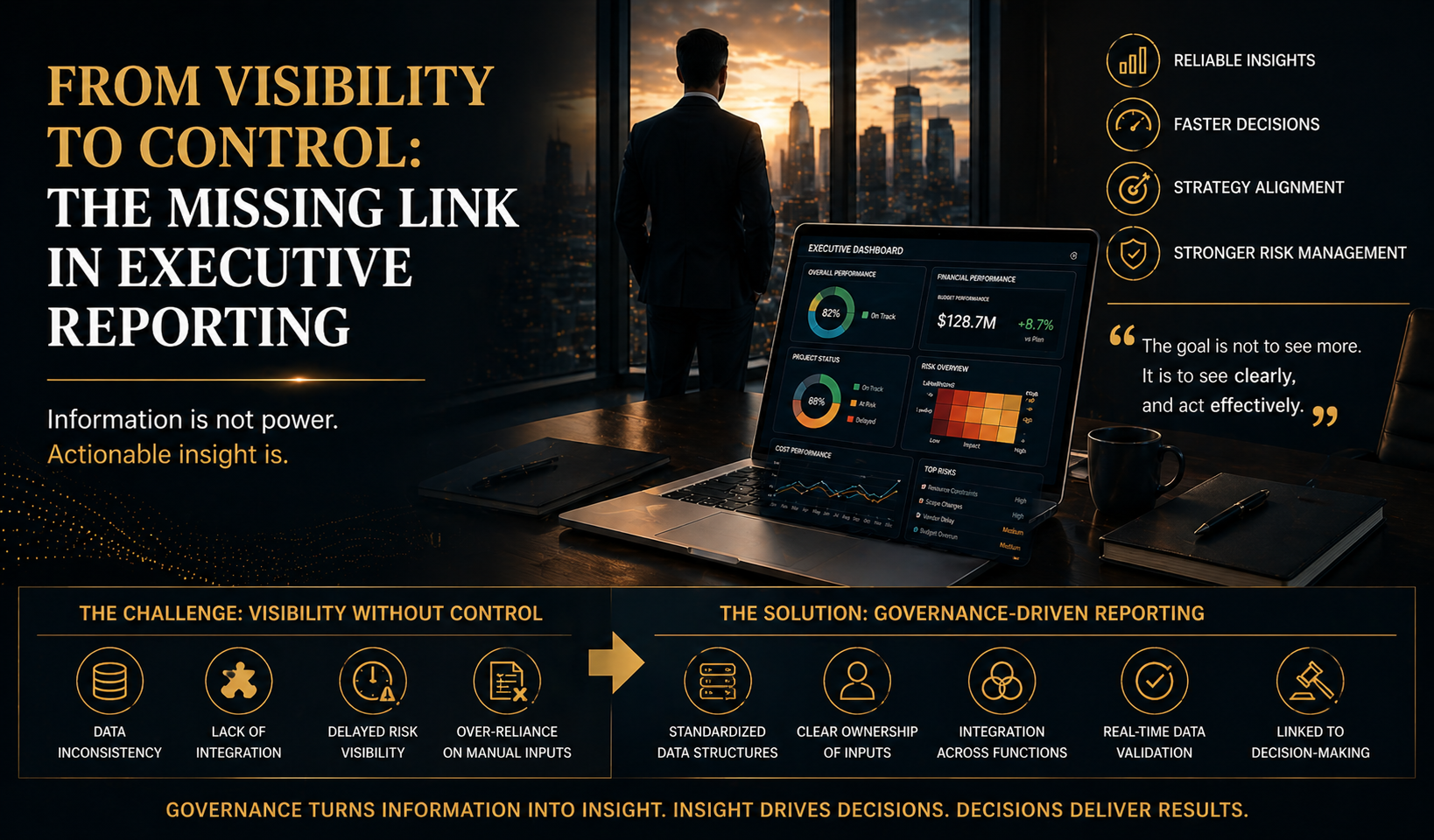
Without governance, reporting environments frequently suffer from:
- Data inconsistency
- Weak integration between financial and operational metrics
- Delayed or incomplete risk visibility
- Over-reliance on manual inputs
This creates a dangerous illusion of control.
Organizations believe they are informed, while critical risks and performance gaps remain hidden.
Moving From Visibility to Control
To transform reporting into a real decision-enabling system, governance must be embedded within the reporting framework itself.
This requires:
- Standardized data structures
- Clear ownership of reporting inputs
- Integration between projects, finance, and risk
- Real-time or near real-time data validation
More importantly, reporting must be directly linked to decision-making.
A dashboard that does not trigger action is merely a display.
The Impact of Governance-Driven Reporting
When governance is integrated into executive reporting, organizations gain:
- Reliable and actionable insights
- Faster and more informed decisions
- Better alignment between strategy and execution
- Stronger risk management capabilities
The focus shifts from simply seeing data to understanding what requires action.
Final Insight
Governance is not an administrative layer. It is a decision-enabling system.
The goal is not to see more. It is to see clearly, decide confidently, and act effectively.