
Many organizations invest heavily in establishing a Project Management Office (PMO).
Yet despite this investment, projects continue to face:
- Delays
- Cost overruns
- Lack of control
This raises a critical question:
Why do PMOs fail?
The answer is rarely about tools or methodologies.
It is fundamentally about authority and governance.
The Core Problem
In many organizations, the PMO operates as a reporting function, not a control function.
A typical PMO focuses on:
- Tracking project progress
- Updating schedules
- Preparing reports
While these activities are necessary, they are not sufficient to drive performance.
Without governance, the PMO lacks the ability to:
- Influence decisions
- Enforce accountability
- Control outcomes
What Is Missing?
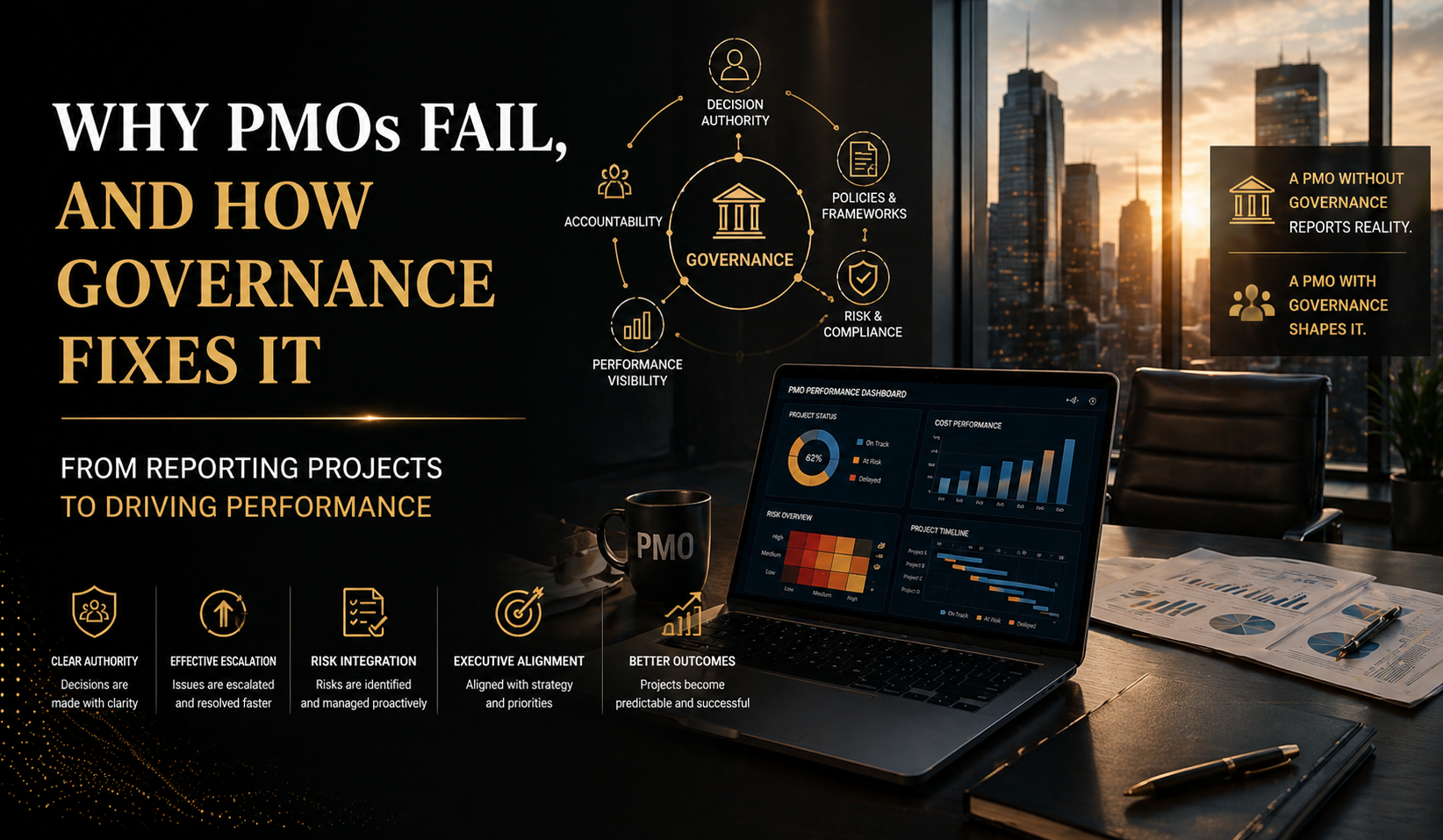
The failure of PMOs is rooted in the absence of critical governance elements:
- Clear decision authority
- Defined escalation paths
- Integration with risk and compliance
- Alignment with executive decision-making
Without these, the PMO becomes passive, observing performance rather than shaping it.
The Shift: From PMO to Governance Engine
To transform the PMO into a value-driving function, governance must be embedded at its core.
This requires:
- Establishing a clear Delegation of Authority (DOA)
- Defining structured decision-making frameworks
- Linking reporting with actionable insights
- Embedding risk management into project controls
This is not an operational enhancement. It is a structural transformation.
The Impact of Governance Integration
When governance is integrated into PMO operations, the results are immediate:
- Faster decision-making
- Effective issue escalation
- Higher predictability of project outcomes
- Improved financial control
The PMO shifts from tracking performance to driving performance.
Final Insight
The distinction is clear:
- A PMO without governance reports reality
- A PMO with governance shapes reality
Closing Thought
Organizations do not fail because they lack PMOs.
They fail because their PMOs lack authority, structure, and governance.
When governance is embedded, the PMO becomes not just a function, but a strategic control engine.