
Transform Your Project Management Office from a Administrative Bureaucracy to a Strategic Accelerator.
In today’s volatile business landscape, organizations invest billions in ambitious, high-stakes project portfolios. To govern these investments, most establish a Project Management Office (PMO). Yet, surprisingly, many PMOs fail to deliver meaningful value, often becoming perceived by executives as bureaucratic bottlenecks rather than strategic enablers.
The core reason is fundamental: Traditional PMOs were designed for a different era. They were structured as administrative “Reporting Hubs”—reactive entities obsessed with ticking boxes, standardizing templates, and compiling retrospective reports that simply tell the C-suite “what already happened” without explaining “why” or “what to do next.”
The Trap of the Reporting Hub
Traditional PMOs often become trapped in a vicious cycle of administrative complexity. They require project managers to fill out countless forms, resulting in a deluge of inconsistent, delayed, and backward-looking data. The executive team receives a 50-page report, yet remains blind to the real portfolio risks and profitability.
This approach fails for three critical reasons:
-
Disconnected from Strategy: Focus is on managing projects “right” (adherence to process) rather than ensuring the organization is managing the “right” projects (those aligned with strategic ROI).
-
Backward-Looking: Reports are compiled after deadlines pass or budgets are blown, making proactive course correction impossible.
-
Information Overload, Zero Insight: Data is abundant, but actionable intelligence for confident executive decision-making is completely absent.
Moving to a Value Driver PMO
The modern enterprise requires a fundamentally different PMO model: the Value Driver PMO. This entity does not just monitor projects; it accelerates strategy execution.
A Value Driver PMO shifts focus from administrative outputs to tangible business outcomes. It is lean, digitized, and strategically aligned.
Here is how the transition is made:
-
Strategic Portfolio Management (SPM): Instead of merely tracking progress, the PMO advises leadership on resource allocation to ensure 100% of the portfolio directly supports the strategic vision.
-
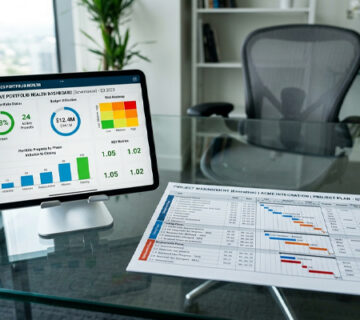
Forward-Looking & Predictive Analytics: Leveraging advanced tools (like Power BI and AI-augmented reporting) to look around corners and identify potential risks and budget variances before they become crises.
-
Automated Data Governance: Implementing tools (like n8n and SAP integrations) to eliminate manual reporting bureaucracy, ensuring a reliable, real-time “single source of truth.”
-
Strict Discipline & Recovery: Imposing rigorous oversight and decisively intervening to rescue failing projects or cancel those that no longer align with strategy.
A traditional PMO is a cost center. A Value Driver PMO is an asset that directly impacts organizational profitability and competitive advantage. By focusing on clarity of governance, structured execution, and intelligent data utilization, executives can transform their PMO into a disciplined accelerator that guarantees portfolios deliver their promised strategic value.