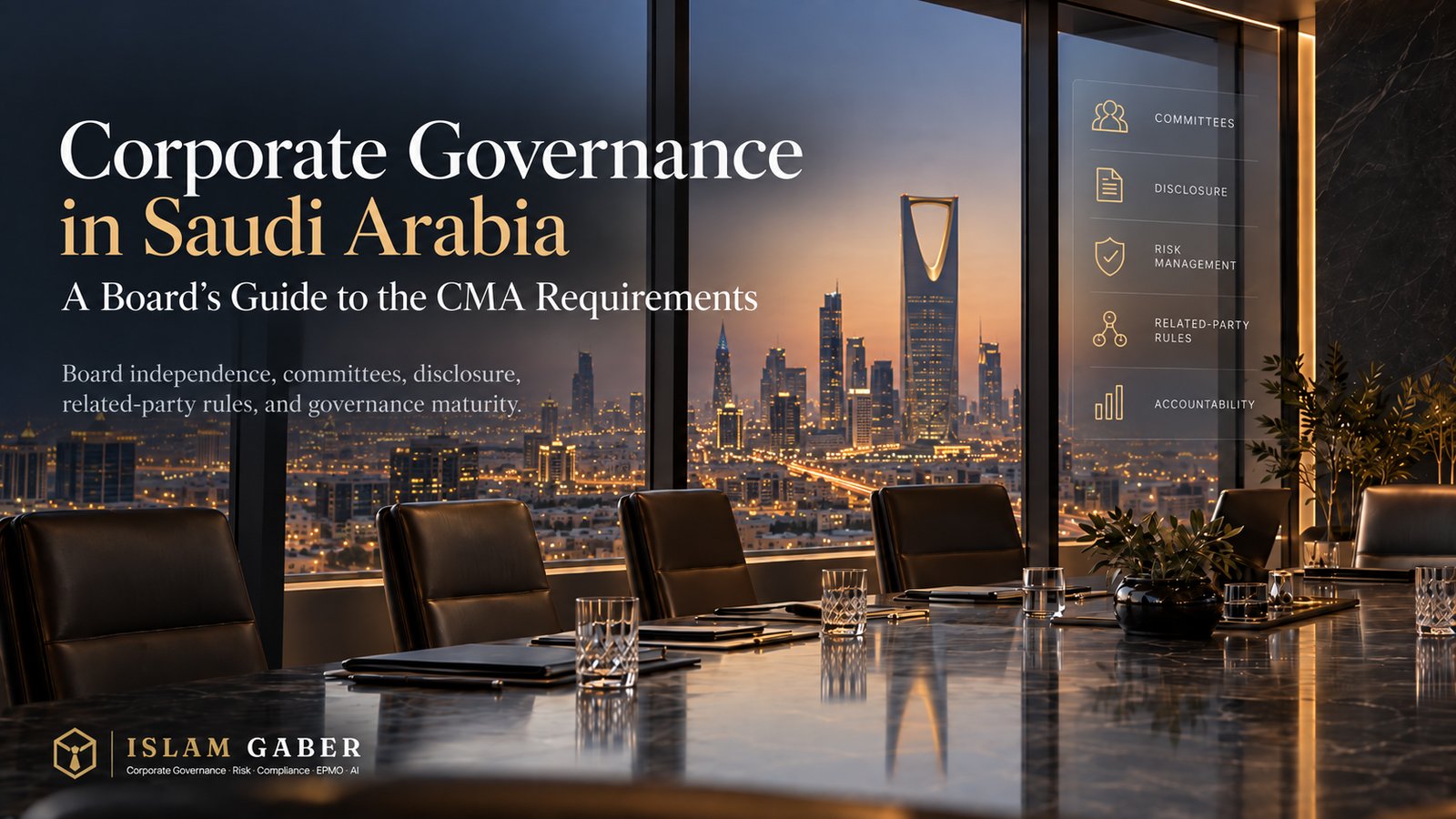
In Saudi Arabia, corporate governance is no longer a compliance checkbox. It is a national agenda — and boards are personally accountable for it.
Vision 2030 has tied the Kingdom's economic transformation to investor confidence, transparency, and institutional discipline. The Capital Market Authority (CMA) has translated that ambition into one of the region's most developed governance frameworks, and the new Companies Law has extended governance expectations far beyond the stock exchange.
For directors and executives, the question is no longer whether governance applies to them — it is whether they can demonstrate it.
What the CMA Regulations Actually Require
The CMA Corporate Governance Regulations set the reference model for companies listed on the Saudi Exchange (Tadawul). The core obligations every board should have answers for:
- Board composition and independence — a meaningful portion of the board must be independent directors (at least two members or one-third of the board, whichever is greater), with independence tested in substance, not just form
- Separation of leadership roles — the Chairman may not hold any executive position in the company; oversight and management must not sit in the same hands
- Board committees — an audit committee is mandatory, alongside remuneration and nomination committees with defined charters and qualified members
- Disclosure and transparency — an annual board report covering governance practices, remuneration, risks, and internal control effectiveness
- Shareholder rights — properly convened general assemblies, fair voting procedures, and protection of minority shareholders
- Related-party transactions — declared conflicts, board and assembly approvals, and no director voting on his own transaction
- Internal control, risk and compliance — functioning internal audit, risk management, and compliance structures that report to the right level
Mandatory Versus Guiding — Read the Difference Carefully
Not every article in the regulations carries the same weight. Some provisions are mandatory; others are guiding, applied on a comply-or-explain basis. Mature boards treat the guiding provisions as a roadmap, not an exemption — because investors, regulators, and rating agencies read the "explain" column closely.
Beyond Listed Companies
The updated Companies Law brought modern governance duties — director responsibilities, conflicts of interest, audit requirements — to closed joint-stock companies and LLCs as well. Family businesses preparing for succession or IPO, and government-related entities under performance mandates, are now building governance frameworks for the same reason listed companies do: control, continuity, and credibility.
Where Boards Commonly Fall Short
After assessing organizations across the Kingdom and the Gulf, the same gaps appear repeatedly:
- Charters and policies exist on paper, but decision rights and delegation of authority are undefined in practice
- Independent directors who are independent in name, not in behavior
- Audit committees that review financials but never test internal control effectiveness
- Related-party transactions identified after the fact, not declared before it
- No measurement — the board cannot answer "how mature is our governance?" with evidence
How to Get Ahead of It
Start by measuring. A structured governance assessment — scoring your current maturity against the CMA framework, COSO, and the G20/OECD principles — turns governance from opinion into a number your board can track, benchmark, and improve. That is precisely what the RASEKH™ Governance Index was built for: a Governance Score, domain-by-domain gaps, a board-ready improvement roadmap, and a verifiable certificate any third party can check.
The Bottom Line
In today's Saudi market, governance is a competitive asset. The boards that treat the CMA requirements as a floor — and build measurable, working governance above it — are the ones that attract capital, pass scrutiny, and stay in control of their growth.