

The owner thinks he sees the whole company. He sees what reaches his desk.
In founder-led and family-owned companies, a small circle forms around the owner: a long-serving general manager, a finance head, an office director, sometimes a relative. They earned that position over years of loyalty, and in the early days they were the company's backbone.
But as the business grows, the same circle can turn from a bridge into a wall. Information no longer flows to the owner. It flows through someone first — and arrives smaller, later, and softer than it left.
How a Company Looks From the Top
Consider a common situation. Sales are reported as "slightly behind plan, recovering next month". Receivables are "being followed up". A key client's complaint has been "handled". Each statement is technically true. Together, they hide a business that is running short of cash.
The owner finds out months later — from the bank, not from the team. Nobody lied. The information was simply summarized, delayed, and framed by people who believed they were protecting the owner from noise.
This is how gatekeeping usually works. It is rarely deception. It is a series of small, reasonable-looking choices, each made by someone who controls the path to the top.
Why Gatekeepers Form
Gatekeepers are rarely appointed. They emerge. The owner's time is limited, so someone starts summarizing. The owner dislikes surprises, so someone starts softening bad news. The owner trusts a few people more than others, so everyone else learns to route through them.
Over time, the role becomes powerful precisely because it is informal. A gatekeeper has no written mandate — and therefore no written limits.
The Six Filters
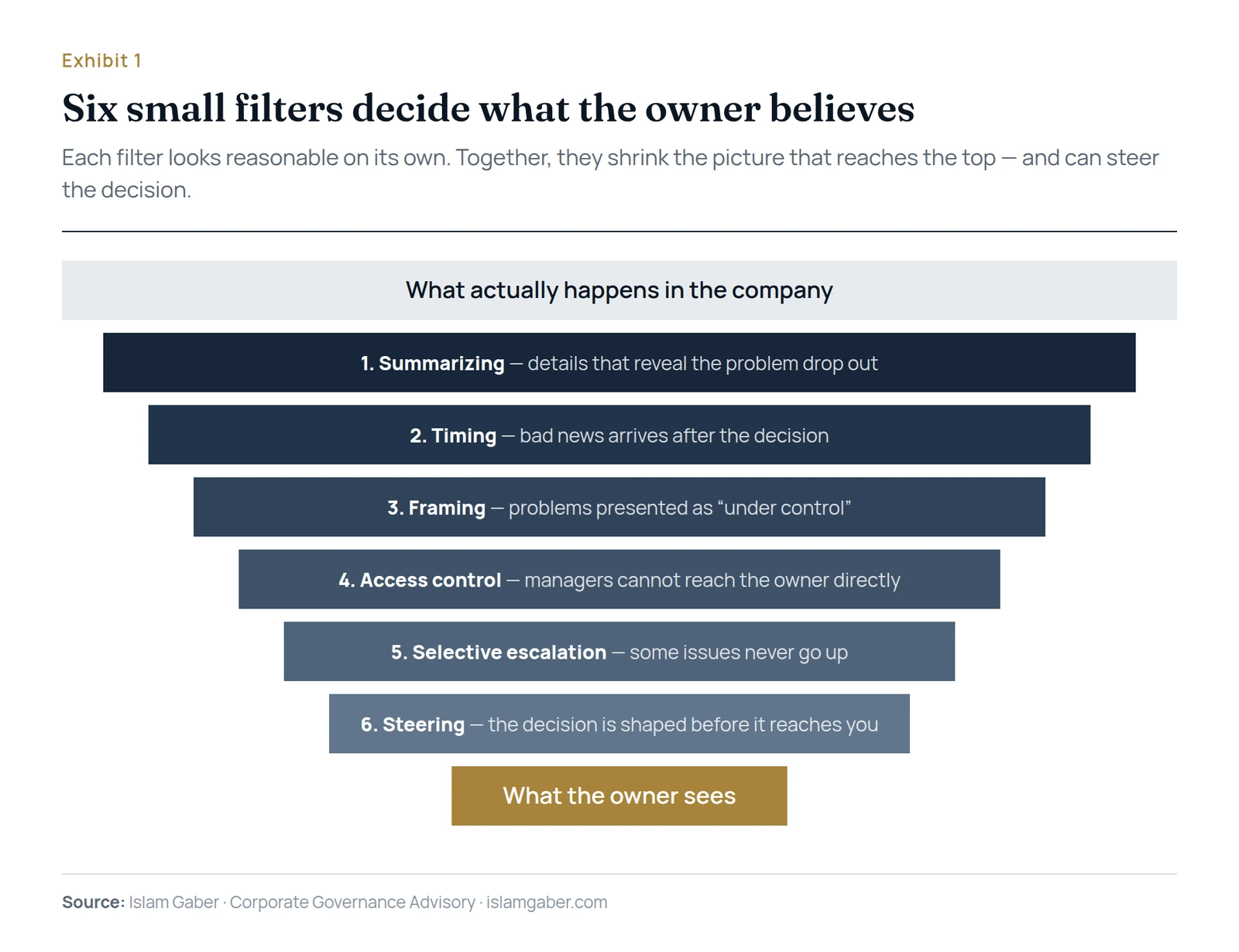
- Summarizing — the owner receives a short update, and the details that reveal the problem are lost along the way
- Timing — bad news arrives after the decision has already been made
- Framing — a problem is presented as "under control" before anyone has verified it
- Access control — managers learn that reaching the owner directly is unwelcome
- Selective escalation — some issues go up immediately; others never go up at all
- Steering — information arrives shaped to lead the owner toward a decision that, in practice, has already been made
Each filter on its own is minor. Together, they mean the owner's picture of the company is drawn by a few people. If their judgment is excellent, the company is lucky. If it is not, nobody finds out until the damage is visible from the outside.
Warning Signs
- The owner hears about serious problems from outsiders — banks, clients, auditors, regulators — before hearing about them internally
- Reports are consistently positive, while cash flow, delays, or staff turnover tell a different story
- Department heads communicate with the owner only through one or two people
- Nobody outside the inner circle has presented to the owner or the board in the past year
- Questions about the numbers are answered with confidence, but rarely with documents
- New managers who raise concerns tend to leave within their first year
What It Costs the Business
- Late decisions — problems reach the top after the cheapest moment to fix them has passed
- False confidence — the owner signs off on plans based on a picture that is cleaner than reality
- Lost talent — capable managers leave when they cannot be heard without permission
- External exposure — regulators, auditors, and banks discover issues before the owner does, which damages credibility
- Concentration of power — whoever controls information gradually controls decisions
Two Reporting Architectures
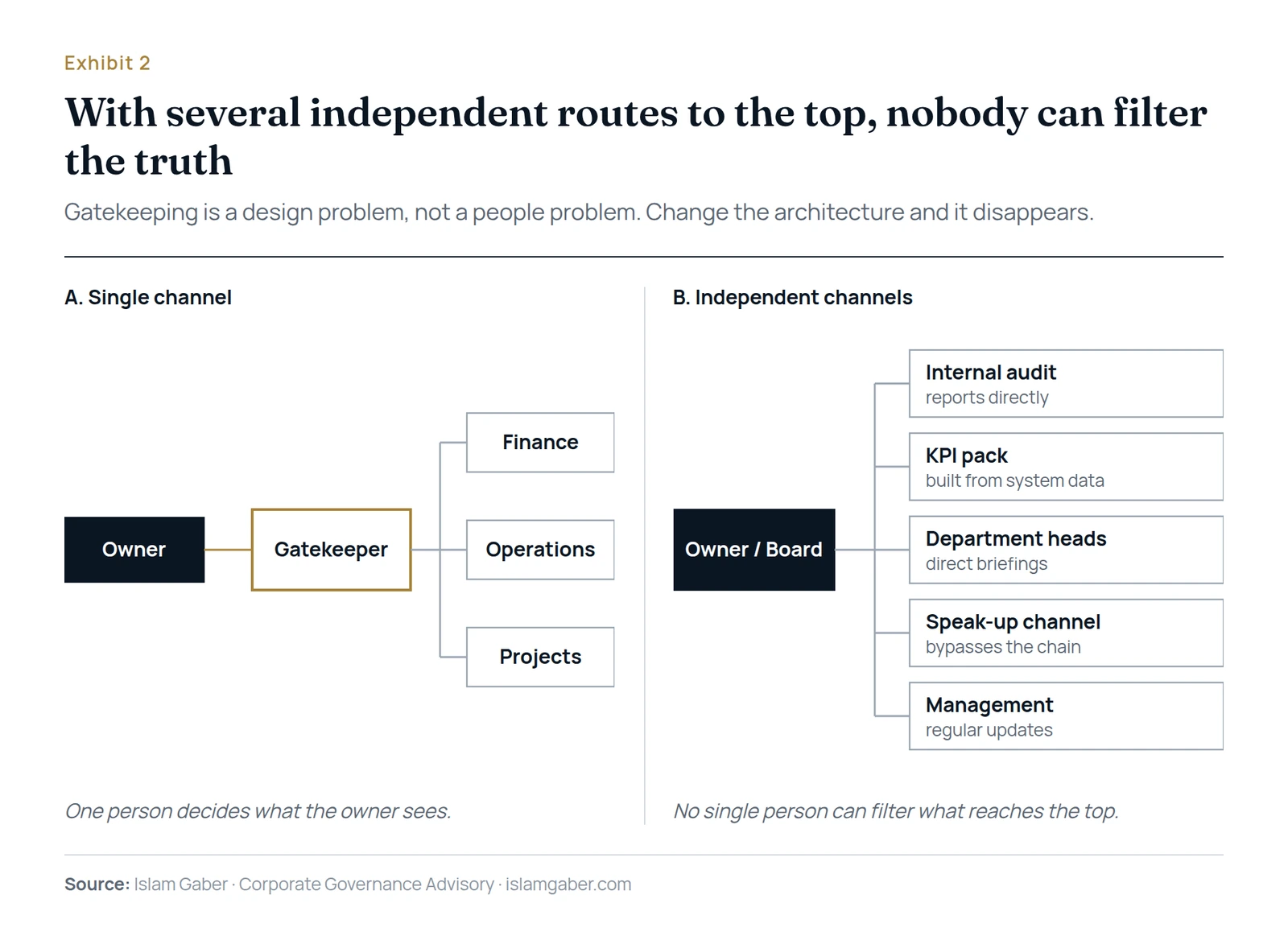
The solution is not to remove trusted people. It is to design a reporting structure in which no single person stands between the owner and the truth:
- An independent assurance line — internal audit and risk functions that report directly to the board or the owner, not through management
- A standard reporting pack from source systems — the same indicators every month, built from system data, so nobody decides what to include
- Direct exposure — the owner and board hear regularly from department heads, not only from summaries of them
- A protected speak-up channel — a clear, safe route for employees to raise concerns without passing through their chain of command
- Verification, not reassurance — important claims are backed by evidence when asked
The Gatekeeper Self-Check
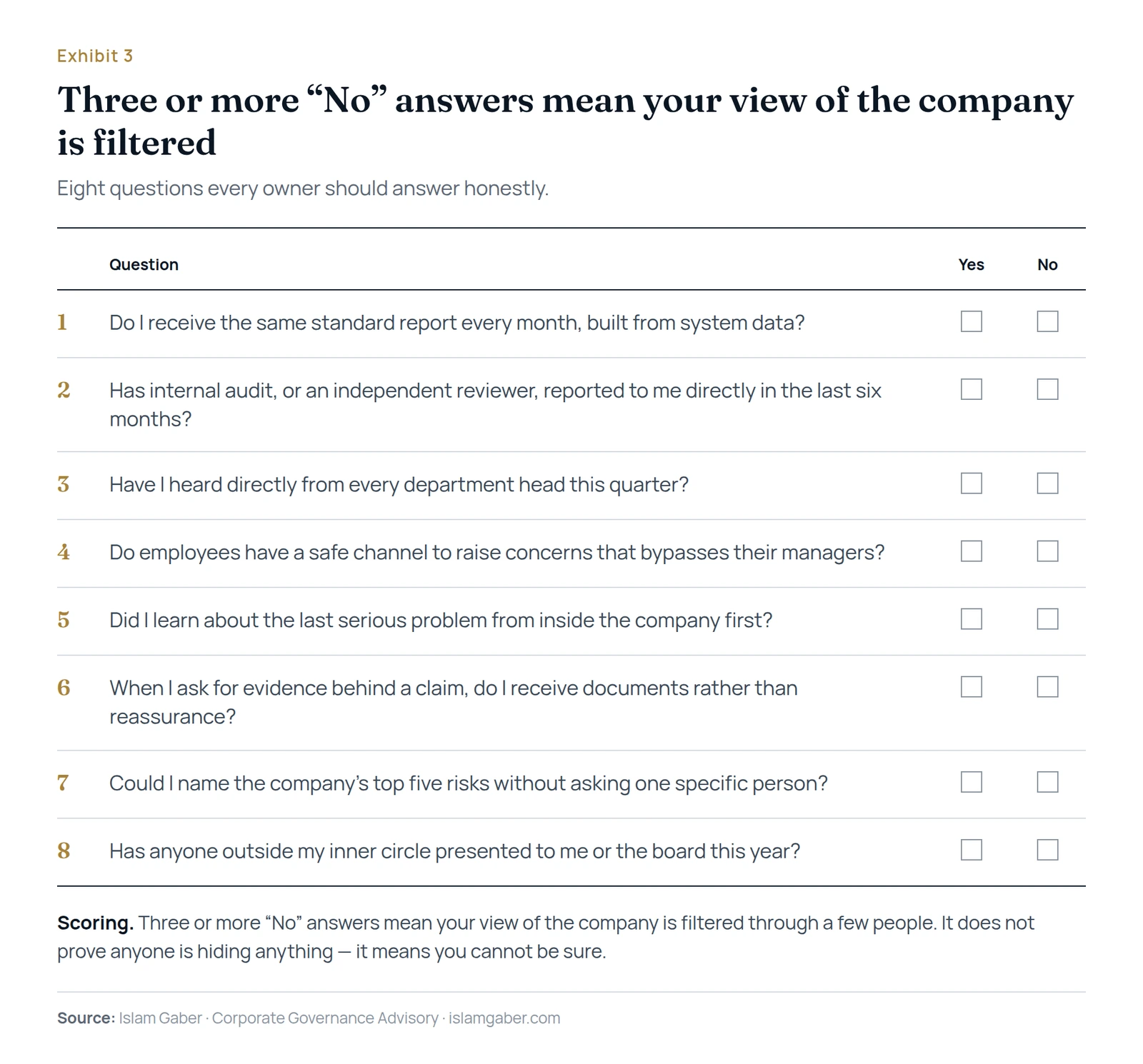
Answer honestly:
- Do I receive the same standard report every month, built from system data?
- Has internal audit, or an independent reviewer, reported to me directly in the last six months?
- Have I heard directly from every department head this quarter?
- Do employees have a safe channel to raise concerns that bypasses their managers?
- Did I learn about the last serious problem from inside the company first?
- When I ask for evidence behind a claim, do I receive documents rather than reassurance?
- Could I name the company's top five risks without asking one specific person?
- Has anyone outside my inner circle presented to me or the board this year?
Three or more "no" answers mean the owner's view of the company is filtered. That does not prove anyone is hiding anything. It proves the owner cannot be sure.
A 30-Day Plan for Owners
- Week 1 — Ask for the raw version. Request one monthly report directly from the system, unedited, alongside the usual summary. Compare the two.
- Week 2 — Hold skip-level meetings. Meet every department head individually, without their manager or the usual intermediary, and ask what the owner does not hear.
- Week 3 — Open a protected channel. Establish a confidential way for employees to raise concerns, with a clear promise of no retaliation and a named independent recipient.
- Week 4 — Fix the reporting pack. Agree on a standard set of indicators, each with a named data owner and a defined source, delivered every month in the same format.
Keep the Circle, Remove the Wall
None of this requires pushing trusted people aside. The aim is to change their role from filter to coordinator. A chief of staff or general manager can still prepare the agenda and follow up on decisions — but the information itself should reach the owner through several independent routes, never through one person alone.
Measuring It
The RASEKH™ Governance Index assesses reporting, oversight, and decision-making across 15 governance domains, with every score backed by named evidence. It shows the owner the organization as it is — not as it is described.
The Bottom Line
Trust built the company. Structure is what protects it as it grows. An owner who depends on a few people to see the business is not fully in control. They are in someone else's hands, however loyal those hands may be.