

A clean audit report is evidence of a healthy company only when the auditor was free to write a different one.
The audit committee meets for one hour, immediately before the board. The external auditor presents twelve slides and closes with the sentence everyone expects: no significant matters to report. Internal audit follows. Fourteen reports this year, no high-rated findings, all actions in progress. The chairman thanks both teams, and the meeting ends ten minutes early.
It has been this way for six years. Nobody in the room can recall the last time an auditor raised something the committee did not already know. Everyone draws the same conclusion from that: the company is in good order.
It may be. But consider a ruling announced in the Saudi market in May 2026. The Capital Market Authority's appeal committee convicted eleven current and former board and audit committee members of a listed company. The company's financial statements for four consecutive years had recognised SAR 358 million of revenue, although those who approved the statements knew that collection was unlikely. The fines totalled around SAR 18 million. Several of those convicted were barred from working in regulated entities for up to a year, and six board and committee members resigned.
The ruling confirms a principle that many boards would rather not test. Responsibility for the financial statements rests with the people who approve them. An audit report, internal or external, does not transfer that responsibility. It supports it, and only to the extent that the audit was independent, properly scoped and listened to.
That condition is the subject of this article: how an owner or a board can tell whether the silence from its auditors is assurance, or only silence.
What a Clean Opinion Covers, and What It Does Not
Many owners hear "audited" and understand "safe". The auditor's opinion is narrower than that.
An unmodified opinion states that the financial statements present the company's position fairly, in all material respects. Three limits are built into that sentence:
- Reasonable assurance. A high level of confidence, deliberately short of certainty.
- Materiality. Errors below a set threshold do not change the opinion.
- Sampling and estimates. Most transactions are never examined, and on the largest judgments, such as expected credit losses, project costs to complete and asset values, the auditor starts from management's own estimate and assesses whether it is reasonable.
The opinion does not say that the company is well run, that its controls operate effectively across the business, or that reported revenue will turn into cash. Nor is an audit designed to guarantee the detection of a fraud concealed by senior people acting together.
Internal audit has a wider mandate, but it covers only what is placed in its plan. Between the two, large parts of a company can go unexamined for years while every report remains clean.
The Quieter the Audit, the Wider the Gap: An Illustrative Case
The ruling above states who was held responsible and for what. It does not describe what happened inside the company, and this article does not speculate about it. But the pattern that brings a company to that point is well known, and it is easier to see with numbers.
The case below is illustrative. The group and its figures are invented for this article and describe no real company.
Take a services group with annual revenue of SAR 800 million and net profit of about SAR 90 million.
In the first year, internal audit raises nine high-rated findings and the external auditor's management letter contains eleven points. Receivables older than one year stand at SAR 40 million, against a provision of SAR 20 million.
In the second year, four things change:
- Appointment. The external audit is retendered by the finance department, and the lowest bid wins at a fee 30% below the previous one.
- Scope. The head of internal audit begins reporting to the CFO, who now approves the annual plan. Revenue and receivables leave the plan, on the grounds that the external auditor covers them.
- Reporting. Draft findings are agreed with management, rating included, before they reach the audit committee.
- Follow-through. Open actions are carried forward from one quarter to the next without challenge.
Over the following three years, high-rated findings fall from nine to five, to two, to zero. The management letter shrinks from eleven points to two. The audit committee records the trend as an improvement in its annual report to the board.
Over the same period, receivables older than one year grow from SAR 40 million to SAR 260 million. The provision moves from SAR 20 million to SAR 28 million.
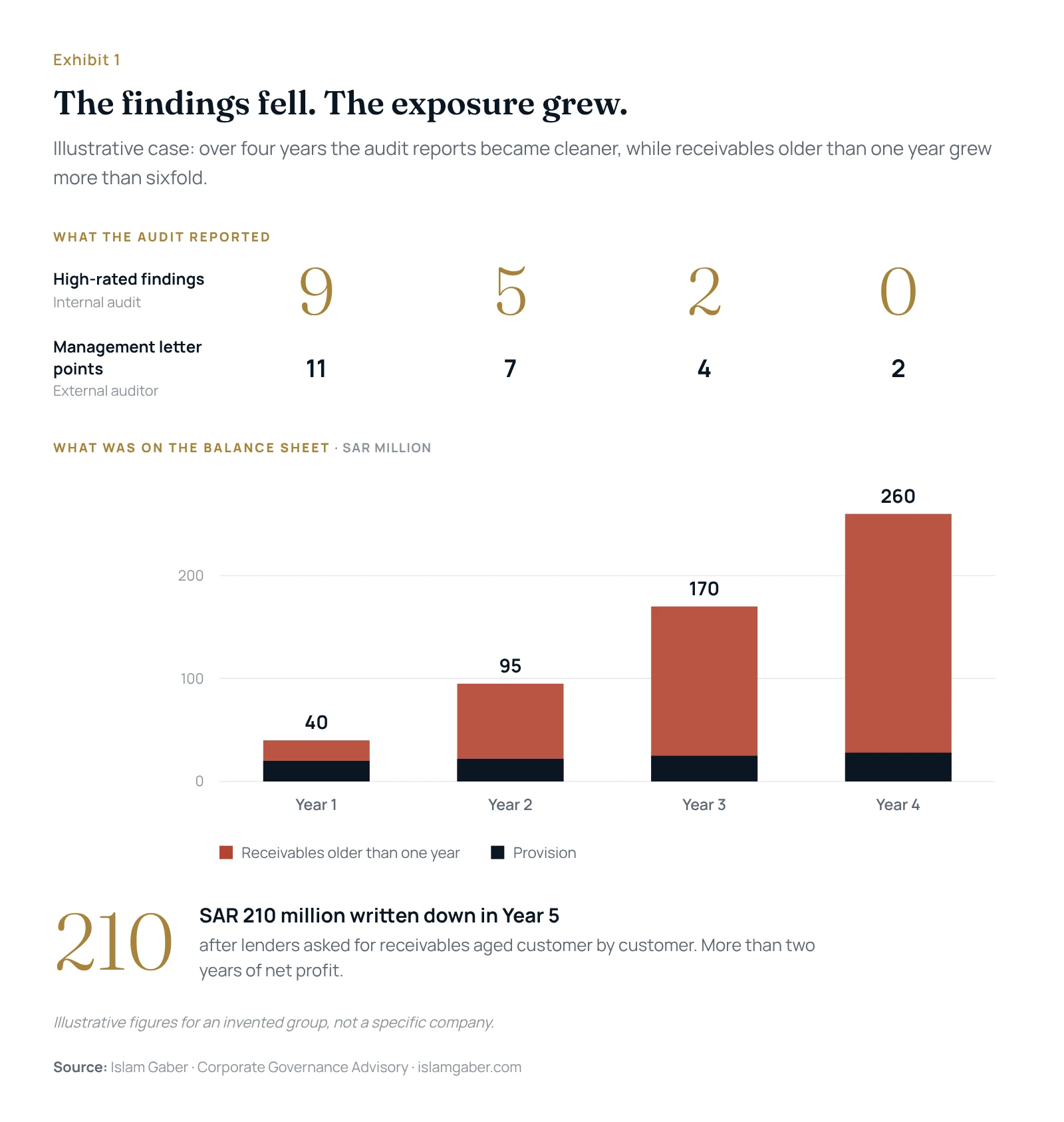
In the fifth year, the group approaches its banks to refinance. The lenders request what no auditor had insisted on: receivables aged customer by customer, with evidence of collection. The outcome is a write-down of SAR 210 million, more than two years of net profit.
The audit did not fail in the fifth year. It went quiet in the second, and the quiet was reported upwards as progress.
Three Readings of a Clean Report
A report with no significant findings can be read in three ways.
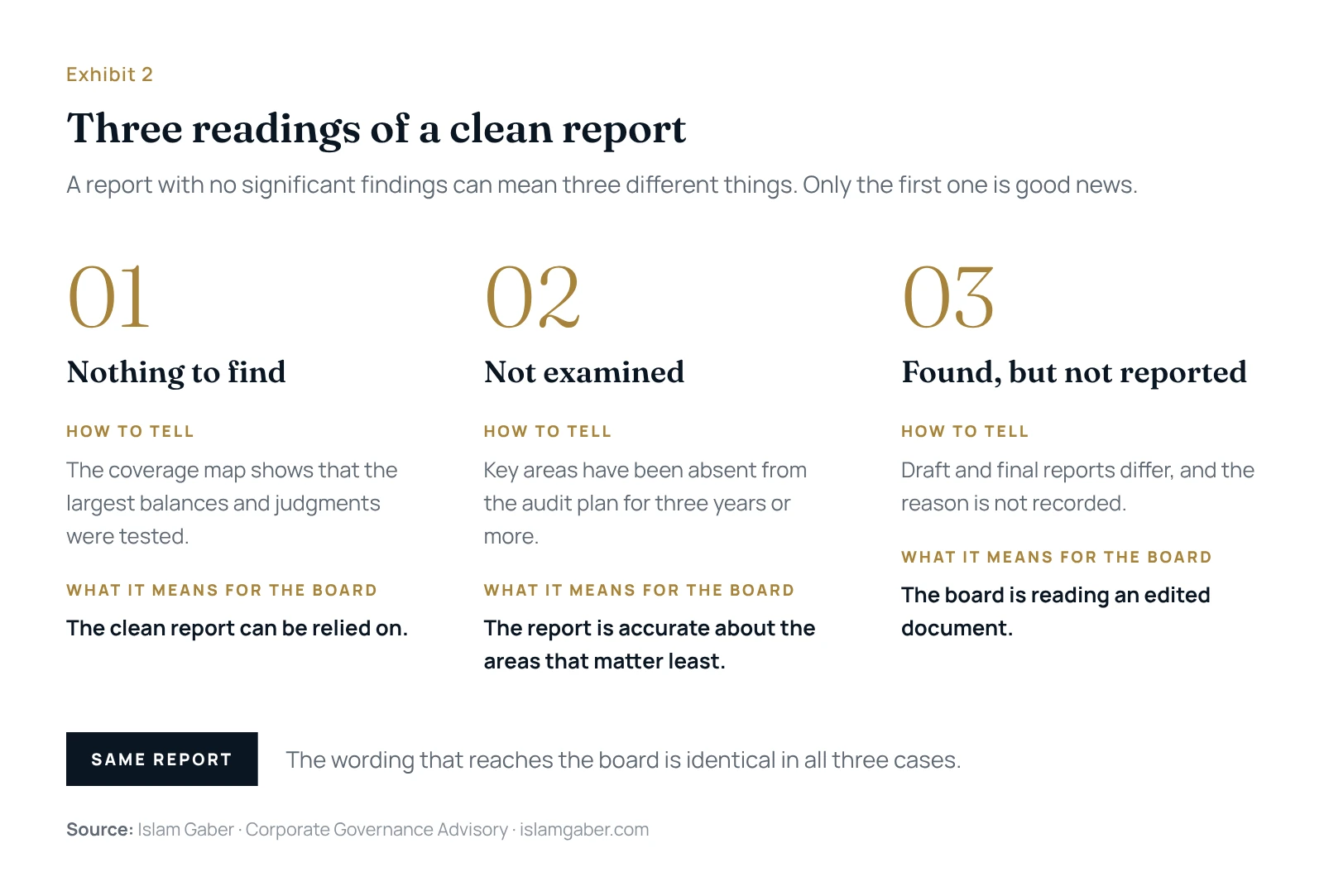
Nothing to find. Possible, but uncommon in a growing company. A business that adds people, contracts, systems and locations every year also adds risk every year.
Not examined. The audit was real, but it covered low-risk areas. The places where the company's money and judgment are concentrated were outside the plan.
Found, but not reported. The finding existed in a draft. It was then reworded, downgraded, merged into a general recommendation or deferred to the following year.
The report itself cannot tell the reader which of the three applies. The arrangements that produced the report can.
The Assurance Chain
Every clean report passes through four links before it reaches the board. Each link can be tested with one question and one piece of evidence, set out below.
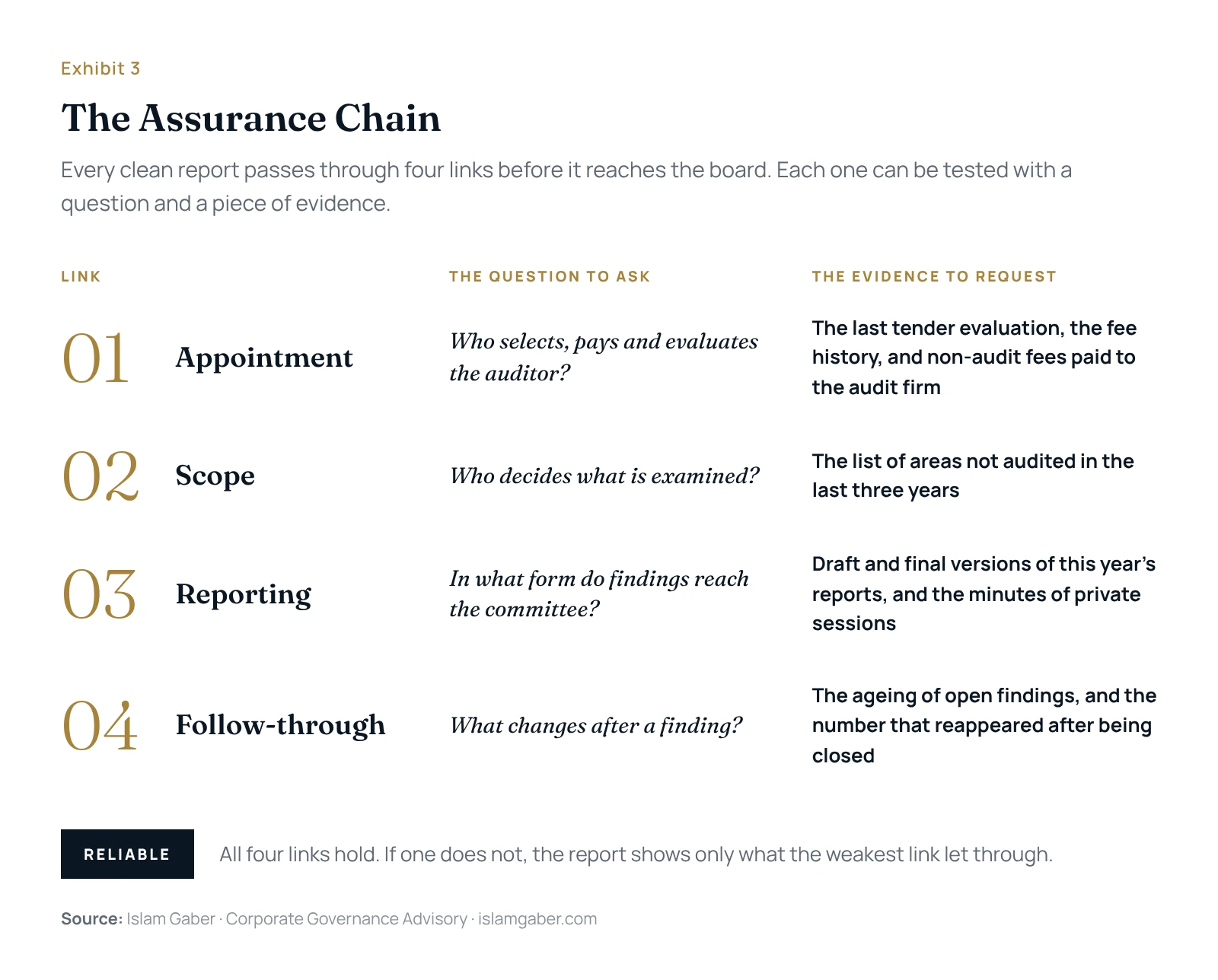
1. Appointment: who selects, pays and evaluates the auditor?
How it weakens. On paper, the audit committee recommends and the shareholders appoint. In practice, finance runs the tender, negotiates the fee and gives the feedback at renewal. A low fee is then delivered with fewer senior hours and smaller samples, and consulting work awarded to the same firm adds a commercial interest in keeping the relationship comfortable.
What good looks like. The audit committee leads the selection, the fee and the annual evaluation of the external auditor, and decides the appointment, appraisal and removal of the head of internal audit.
2. Scope: who decides what is examined?
How it weakens. When the audit plan is set or approved by management, it moves towards subjects that trouble nobody: petty cash, attendance records, branch inventories.
What good looks like. A risk-based plan approved by the audit committee, with coverage mapped against the company's largest balances and most significant judgments: revenue recognition, receivables, major projects, related-party transactions.
3. Reporting: in what form do findings reach the committee?
How it weakens. Confirming facts with management is good practice. Negotiating the rating and the wording is not. When the committee also never meets the auditors alone, it sees only the version that management has accepted.
What good looks like. Findings reach the committee at their original rating, with any change explained. The committee meets the external auditor and the head of internal audit privately, without management, at least twice a year.
4. Follow-through: what changes after a finding?
How it weakens. The same issue is reported each year, and each year the committee notes it. Actions have no owner and no date, so they are carried forward.
What good looks like. Every action has a named owner and a deadline. The committee tracks overdue actions and repeat findings as indicators in their own right.
When all four links hold, a clean report can be relied on. When one does not, the report shows only what the weakest link allowed through.
The Audit Committee's Part
The chain is held together by the audit committee, and the difference between committees is visible in how they use their time.
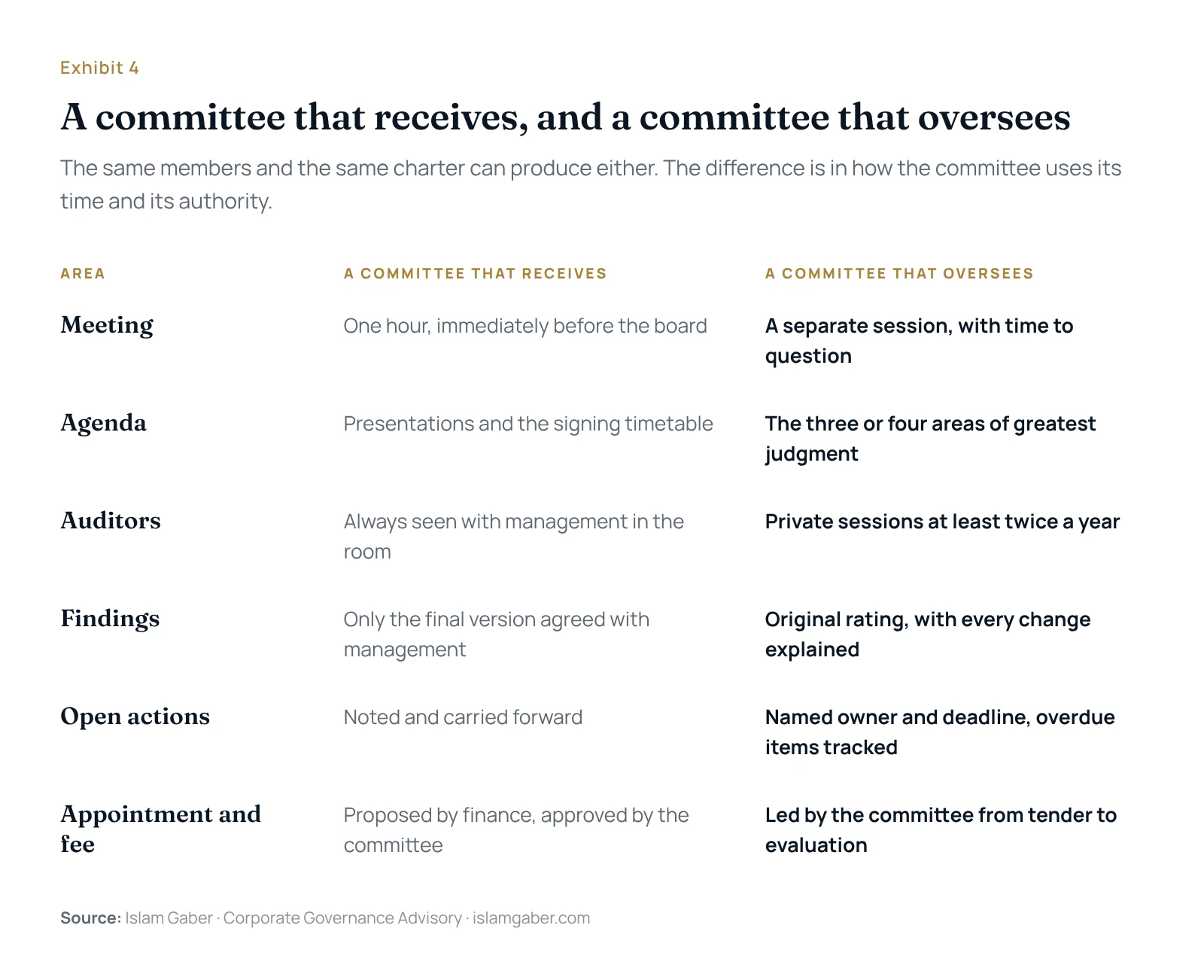
A committee that receives meets for an hour before the board, listens to presentations and asks when the accounts will be signed. A committee that oversees meets on a separate day, reads the papers in advance and spends most of its time on the three or four areas where judgment is greatest. At least one of its members can read a set of accounts critically and is prepared to say that a number does not look right.
Such a committee is not troubled by a difficult finding from its own auditors. It is troubled when a bank, a regulator or a buyer's due diligence team finds what its own auditors did not.
A 90-Day Plan
- Days 1–30: Establish the facts. Request the four pieces of evidence above: the tender and fee history, the three-year coverage map, the draft and final reports, and the ageing of open findings. Hold the first private session with the external auditor and with the head of internal audit.
- Days 31–60: Reset the structure. Move the head of internal audit to a functional reporting line to the audit committee, with an administrative line to the CEO. Bring the external auditor's selection and fee into the committee. Require every finding to be reported at its original rating. Record these changes in the committee's charter.
- Days 61–90: Test where the judgment sits. Commission one focused review in the area of greatest exposure, such as receivables ageing by customer, revenue recognition on long-term contracts or related-party transactions. Place every finding open for more than twelve months on the committee's agenda with a named owner. Make it known to both audit teams that a year without findings will be questioned, not praised.
Six Questions Every Owner Should Ask
- "When did an auditor last tell us something we did not already know?"
- "Who negotiated the audit fee, and what was reduced to reach it?"
- "Which areas of the business have not been audited in three years, and who decided that?"
- "Was any finding downgraded or removed between the draft and the final report this year?"
- "Which findings have been open for more than a year, and who owns them?"
- "If a bank or a buyer examined our receivables tomorrow, would it reach the same figure we did?"
Slow or uncertain answers are themselves a finding.
Measuring It
The RASEKH™ Governance Index assesses internal audit, the oversight of external audit and the audit committee as governance domains in their own right. Across 15 domains and up to 152 indicators, every score is backed by named evidence, showing owners whether their assurance functions are independent, properly scoped and acted on, or simply present.
The Bottom Line
An audit earns its value in the years it has something uncomfortable to say. Owners who want to rely on a quiet audit must first make sure that a loud one was possible: an auditor the committee appointed, a scope set by risk, findings reported as written, and actions that close. Without those four, a clean report proves only that nothing was said.